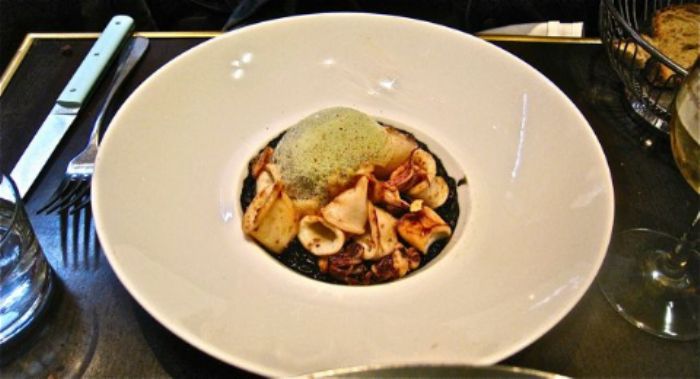
Golden days in Paris

It was still dark when I left the house. As I turned the corner a young fox, looking like a two dimensional angular cartoon character, leaped out in a wide arc from behind a car and melted into the shadows.

I had been tempted to take a taxi to the Eurostar but as I walked along by the pond, it felt good to be the only person out and about, listening to the muffled, waking tweets of the ducks and moorhens on the island. I was just in time – a lighted bus was coming up the High Street. We flew up Castelnau, picking up some single men at bus stops along the way. Workmen in beanie hats and a couple of besuited FT readers with battered briefcases.

Lots of yawning on the almost empty tube… night shifters coming home and others with cases like mine – Kings Cross is now like a work of art compared to its old, grimy self and it’s a joy to walk through to St. Pancras and the Eurostar.
I feel so grateful to all the people who designed it and to those who made it happen. It is such a success and makes travelling a joy. My tax contribution well spent for a change. I bought a carnet of ten metro tickets and settled down to study my Paris A-Z. The hotel was on the Rive Gauche and the No. 4 metro line would take me all the way to Odéon from the Gare du Nord.

A gaggle of Japanese girls, sounding like tiny, twittering sparrows were surrounding their English teacher, who kept counting them anxiously. A man with a giant rucksack on his back was leading a very small boy along, who was totally oblivious of the overhanging rock above him. A spatchcock chicken in the making – I hope not! A tall, hard muscled young man with ginger hair in a buzzcut dressed in becoming blue, a fat man with a bullish bald head, wolfing down croissants and looking contented, a large lady in a floral shirt and dyed blonde hair sticking out every which way, wondering if there would be a full English (breakfast) included at her hotel … variety and spice etc.!

Eurostar - we must already be in France ...

Eurostar – we must already be in France …

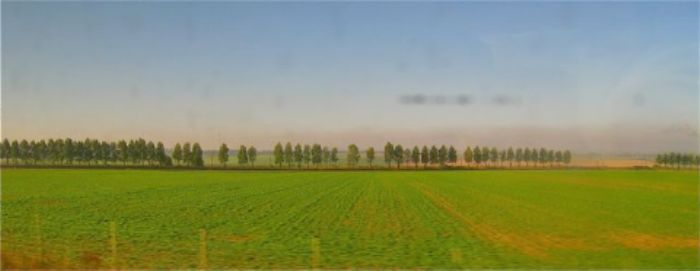
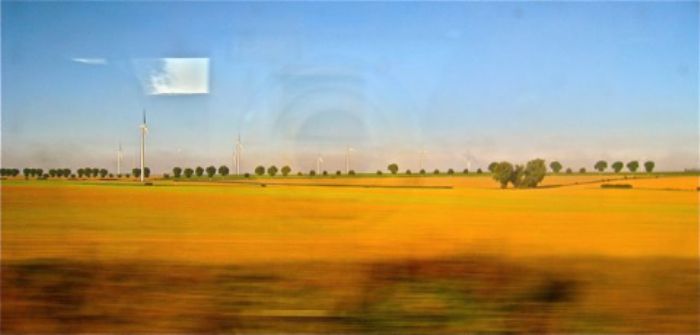
I was booked in standard and the carriage was full. Luckily, I had a window seat. As we left London, the landscape was milky, the train window blurred with a lick of soft mist. I began to doze a little and woke up to find that we were in France already. The landscape said so!

Speeding through the French countryside ...

Speeding through the French countryside …

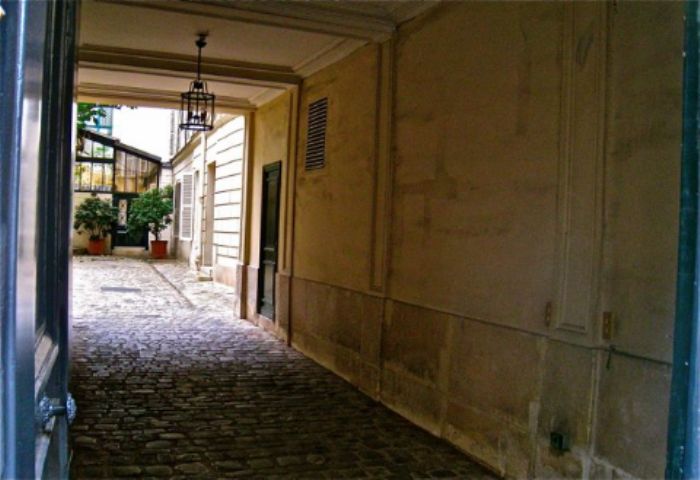
The train was on time and soon enough we were passing walls covered in graffiti on the outskirts of the city. Disgorged into it, the metro spirited me along to Odéon and within minutes I was walking up the pretty cobbled entrance to our hotel, where Hania was leaning over the balcony of our room to greet me.

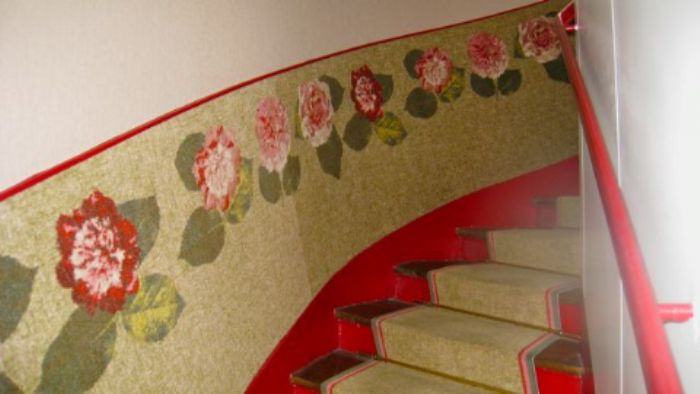
Everything is red and green and covered in roses. Even the walls are carpeted with them! The bathroom is minute but marbled and mirrored to the point that I can see myself too many times from behind – oh dear, not quite as stylish and chic as I’d thought – maybe I should invest in that process that freezes fat cells into extinction.

Roses all the way at 'Les Marronniers'

Roses all the way at ‘Les Marronniers’

There was the threat of a metro strike, so we decided to go first to Fragonard, which has a small musée ‘de parfum’ and a shop to go with… We can walk to lots of places from Odéon but it’s too far to Opéra. ‘ Muguet des Bois’ – ‘savon à l’huile d’abricot, parfumé à la clementine’ – we smell very fragrant already. I wish there was a ‘click and smell’ button for my journal! Things are well priced here and make wonderful ‘cadeaux de Noël’ … The museum is fascinating too and we were lucky to arrive just as a guided tour was setting off – it’s small but if you’re interested in the history of perfume and like perfume bottles through the ages, it’s worth the trip.

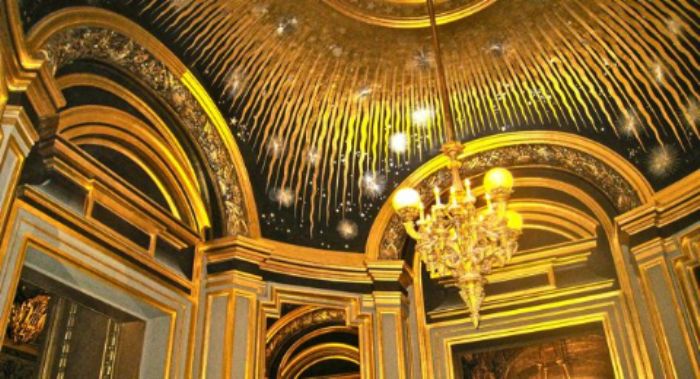
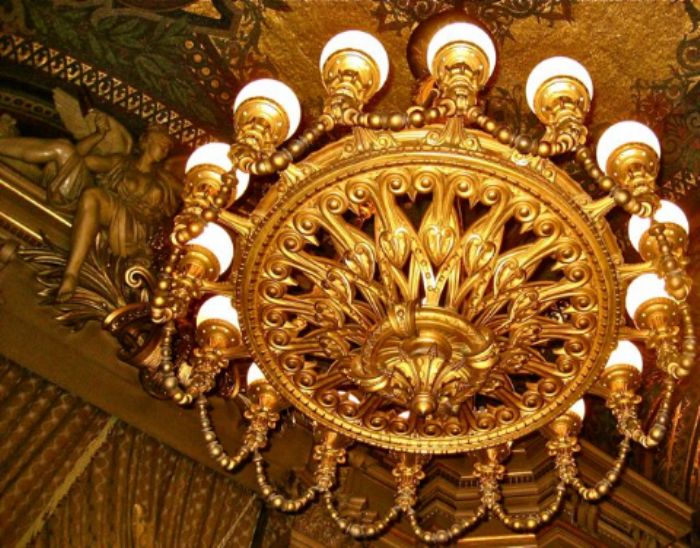
Fragonard is near Galeries Lafayettes and also Opéra Garnier. This last has an unguided tour for 10 euros and so we took advantage of it being just round the corner. Outside on the pavement a young man with bare arms was playing brilliantly on a piano – we stood and watched and marvelled…

Opéra Garnier 1

Opéra Garnier 1

Ceiling at Opera Garnier

Ceiling at Opera Garnier

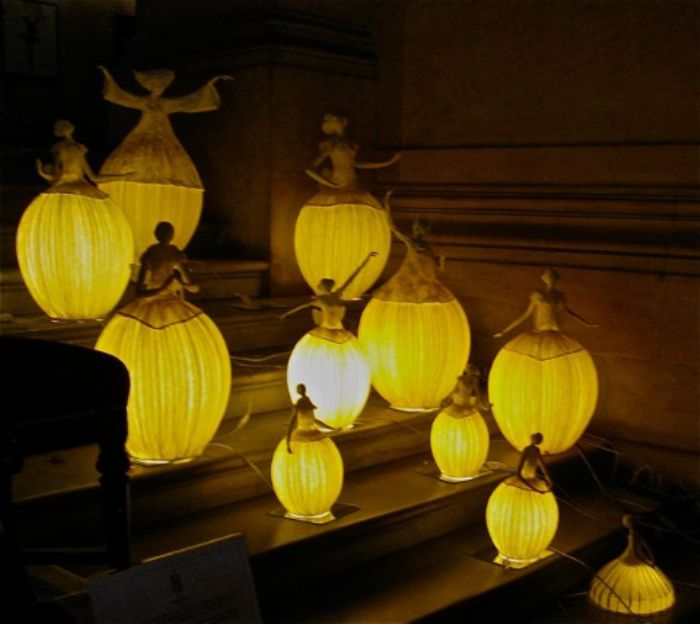
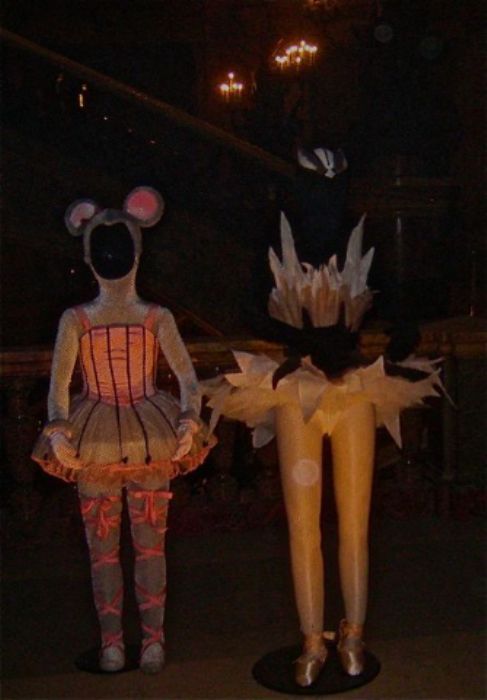
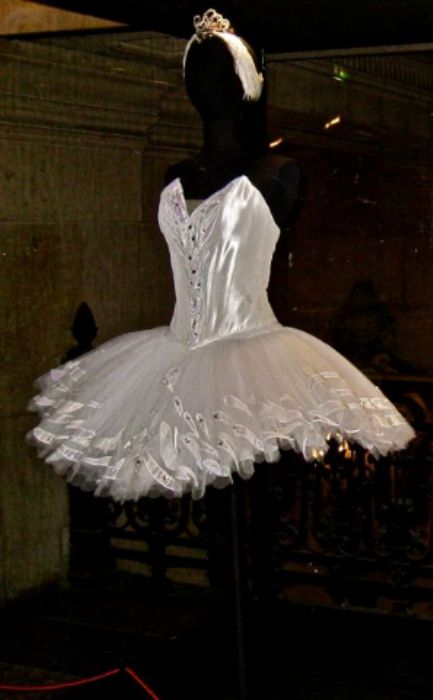
Opera Garnier - dancer

Opera Garnier – dancer

Sonata in yellow ...

Sonata in yellow …

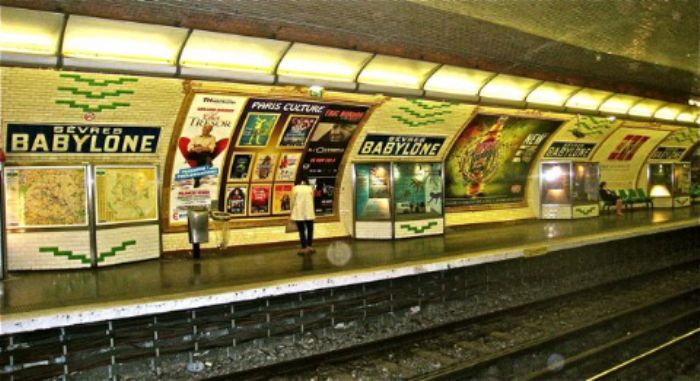
Still threatened by a metro strike tomorrow, we sped down to Sèvres-Babylone and had a ‘café crême’ in ‘Le Bon Marché’. It seems to have become much more upmarket and my purse being more suited to vintage shops, we bought a packet of ‘Petits-Beurre de Lorient’, 27 being the odd magic number on the front, then made our way by metro to Mabillon.

Waiting for the metro to Mabillon

Waiting for the metro to Mabillon

We didn't stop to enquire ...

We didn’t stop to enquire …

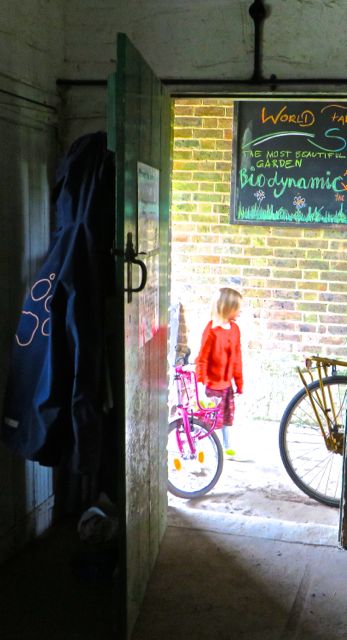
Nearby, Hania remembered a small bistrot called ‘Chez Julien, le lou pescadou’, 16 rue Mabillon and we arrived just in time to snap up the last table for two. Monsieur Julien, a man looking like a favourite uncle, seems to manage the whole thing almost by himself – he races around, throwing out humorous asides here and there – his cooking delights, as does the ‘pot’ of red wine, drafted from a large barrel in the corner. The old Paris definitely lives on here … we walked back along the now familiar streets. The evening was mild. People were sitting outside, making the most of the late summer, which was bravely hanging on.

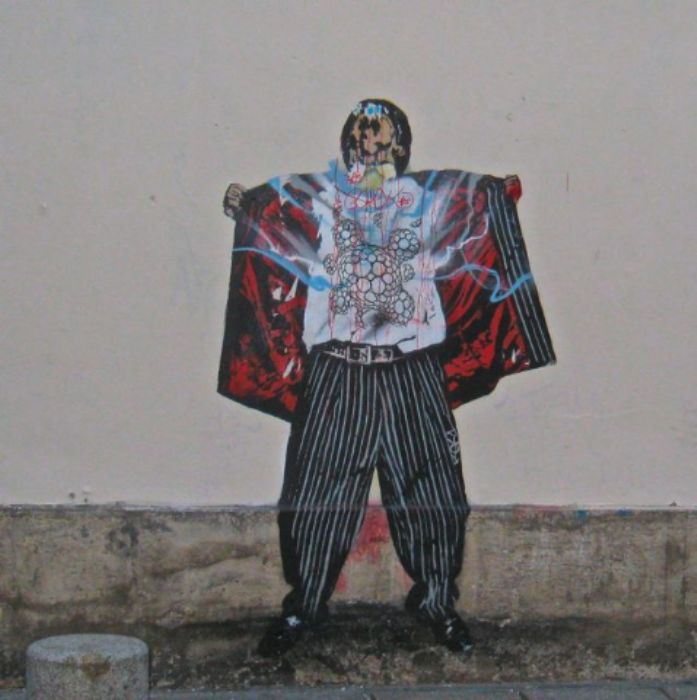
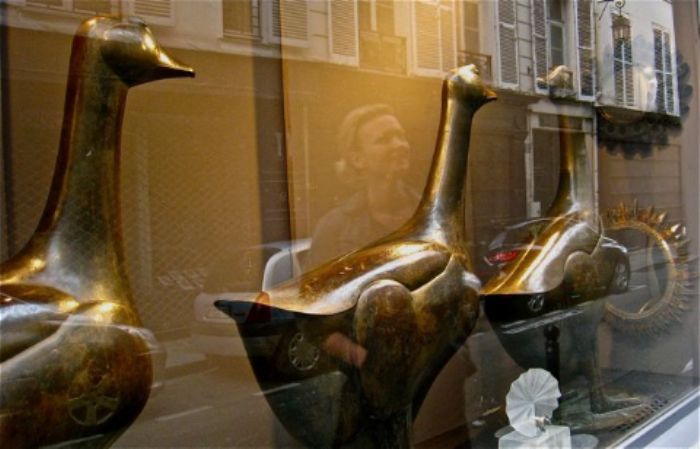
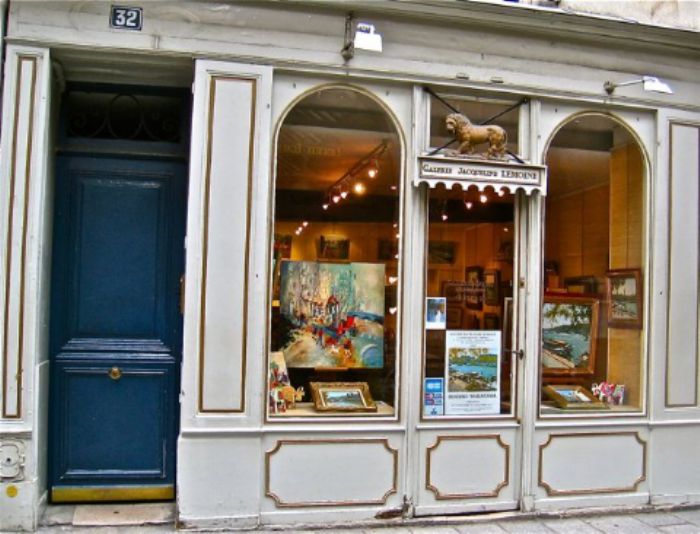
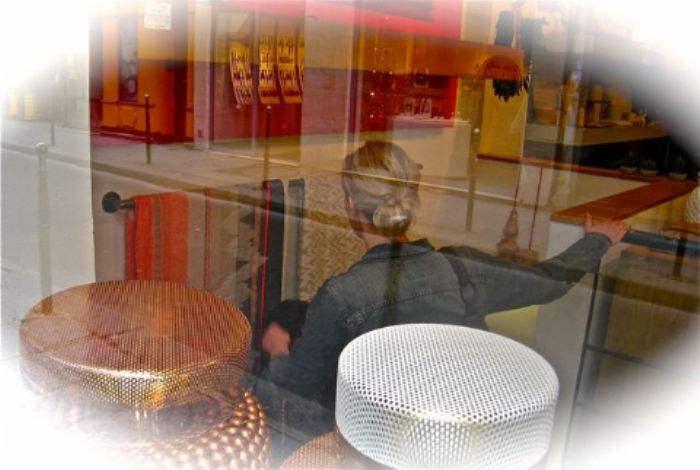
Next morning was bright and sunny. Down the Rue de Seine towards the river there are lots of small art galleries.

Geese on the Rue de Seine

Geese on the Rue de Seine

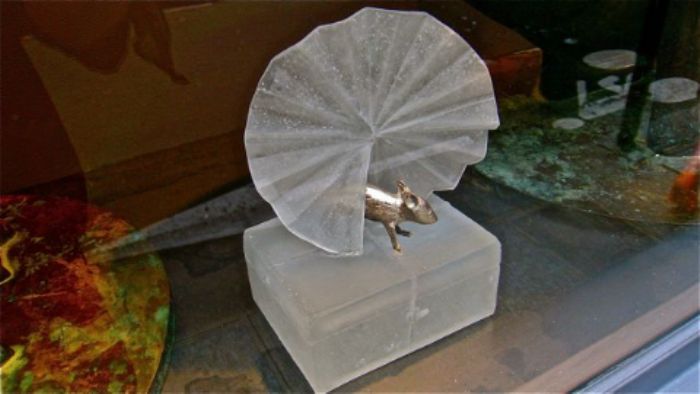
Rue de Seine - the mouse's wedding fan ...

Rue de Seine – the mouse’s wedding fan …

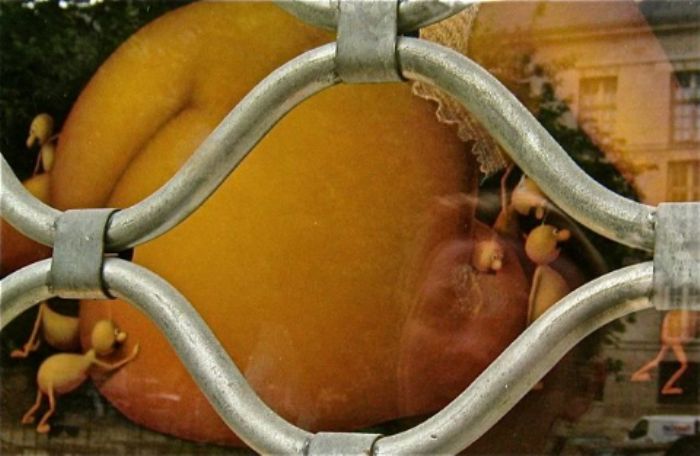
Is this a giant peach or just a large bottom?  Confused ...

Is this a giant peach or just a large bottom? Confused …

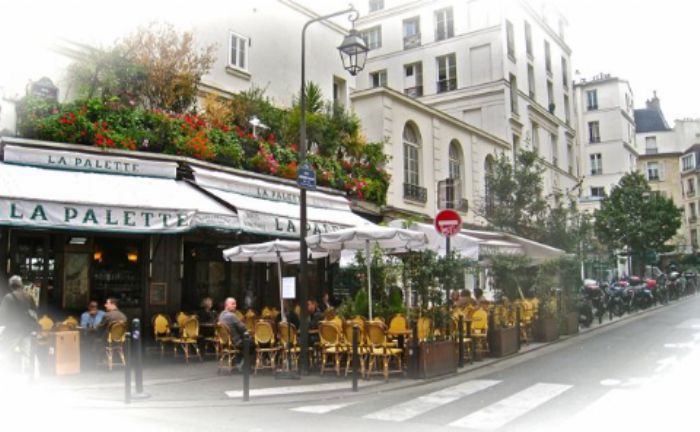
Popular café on Rue de Seine

Popular café on Rue de Seine

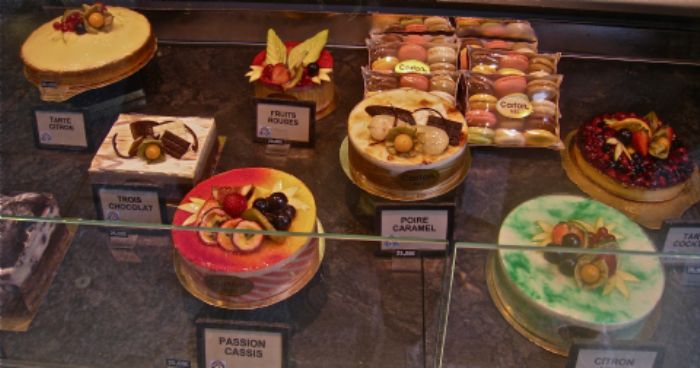
Gâteaux  - Rive Gauche

Gâteaux – Rive Gauche

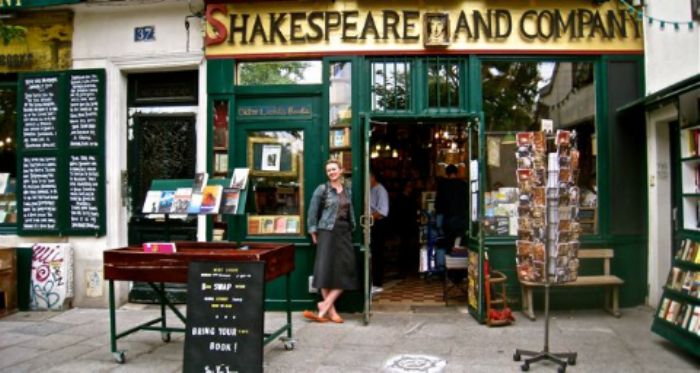
We walked along the river to ‘Shakespeare & Co’ – a bookshop celebrated for being unique – not to be missed! I am always entranced by it and could spend many happy hours there.

Today, somebody was tinkling on a piano upstairs … it’s a place which attracts homing pigeons like a dovecote.

A bookshop by the river Seine not to be missed ...

A bookshop by the river Seine not to be missed …

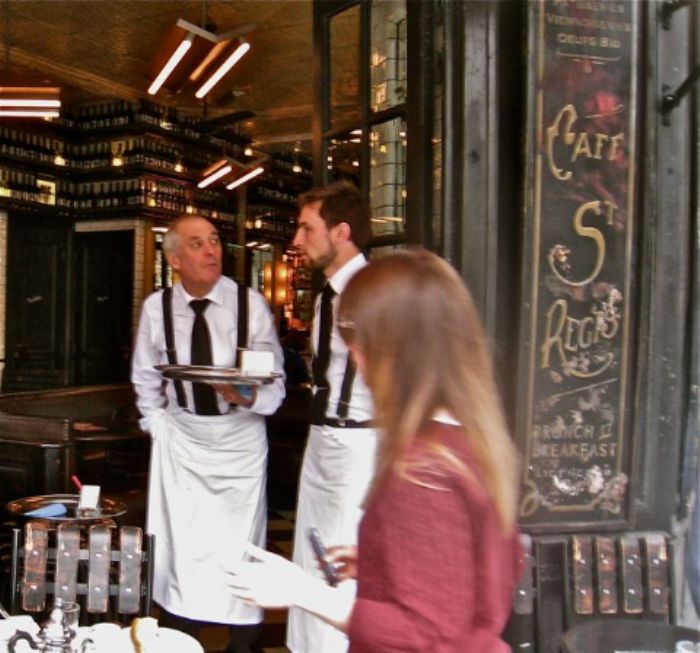
Next it was a late breakfast at the St. Régis – Ile St. Louis. This is a great place for very fresh orange juice, boiled eggs with toast fingers or omelettes with tartines, butter and jam.

The Ile St. Louis is small but exquisite. One of my favourite localities.

A late breakfast on the Ile St. Louis ...

A late breakfast on the Ile St. Louis …

There are some very alluring and friendly boutiques here, which drew us in. Suddenly, somebody was calling out us. It was Rose, a colleague of Hania’s, who was surprised to see her in Paris. I’m always ‘bouleversée’ when I meet somebody I know by chance in another country. How often do you meet people like this, and how often do you just miss them by a street or a metro carriage – like ‘Sliding Doors’ … this was an unexpected treat.

A 'galerie' on the Ile St. Louis

A ‘galerie’ on the Ile St. Louis

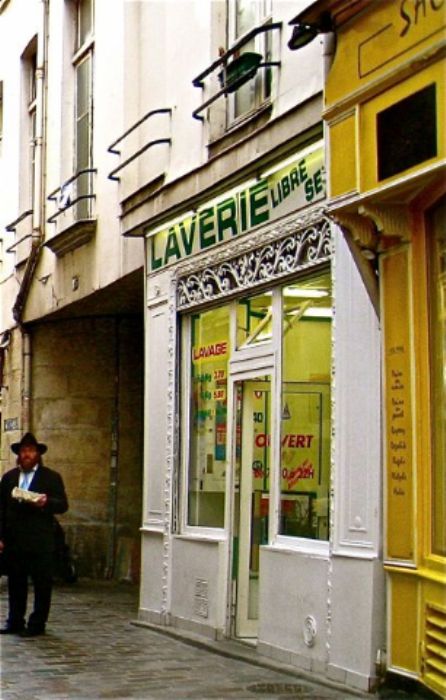
Next stop was Rue des Rosiers in the Marais. The shops here are very tempting – bon chic, bon genre. We walked up from the river through the small locality of St. Paul, which has interesting bric-à-brac and button shops as well as small photography and art galleries in cobbled courtyards. Rustic, romantic restaurants, like ‘Les Vins des Pyreneés’ are also recommended. We pressed onwards, via the Rue de Turenne.

Rue des Rosiers  -  he must be eating a delicious spinach filled borek from Finkelsteins.  The cheese ones are delicious too!

Rue des Rosiers – he must be eating a delicious spinach filled borek from Finkelsteins. The cheese ones are delicious too!

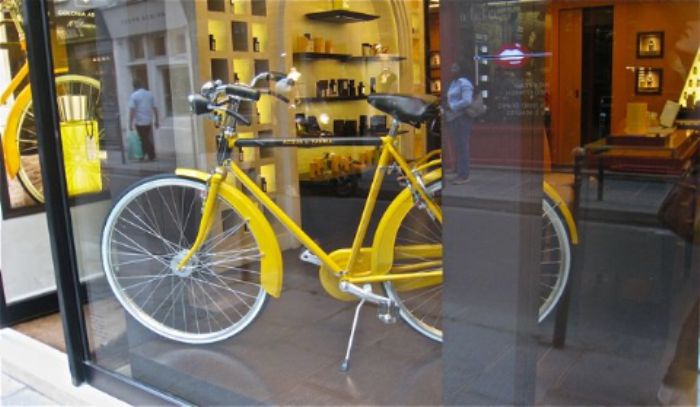
Perfume à la bicyclette ...

Perfume à la bicyclette …

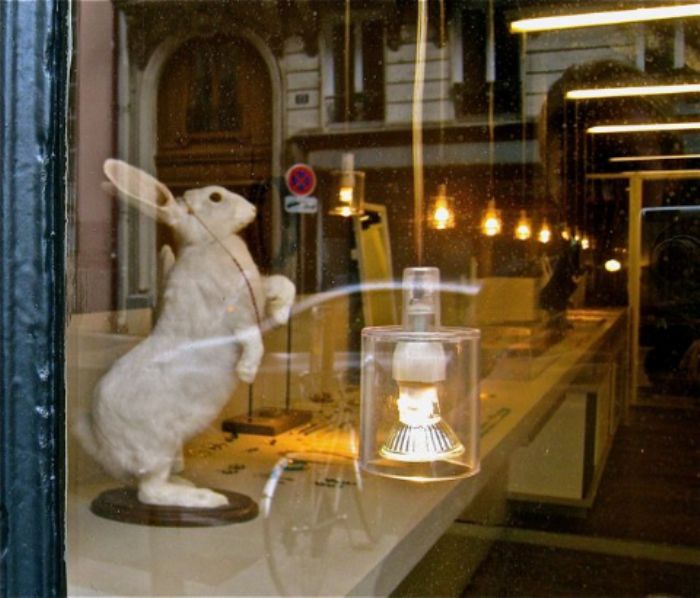
Lapin de Marais, paré de bijoux

Lapin de Marais, paré de bijoux

Shopping in the Marais ...

Shopping in the Marais …

I tracked down a vintage/second hand clothes shop near here and came away with a soft green jacket, traced with small, delicate flowers the same colour – with a silky green lining and seemingly unworn. Ten euros! Perhaps it was a sample from one of the fashion lines. Oh, the joy of a beautiful bargain!

Encounters en route 1

Encounters en route 1

Next on our list was a walk to the Canal St. Martin, north of République. This is an ‘up and coming’ area – maybe the equivalent of Stoke Newington in London. It’s still down at heel in parts but has one of the best bakeries in Paris and sample clothes shops from designers, hoping to make it to Le Marais and other central locations. Some of them have already.

Encounters en route 2

Encounters en route 2

The canal runs deep and limpid green, cutting the area in two. There are minor auction houses, old fashioned shops, which I would love to explore further and bridges over the water every three minutes or so. It’s quite quiet by the water’s edge, with people sitting on benches, some looking melancholy and bereft, others catching your eye as you pass by.

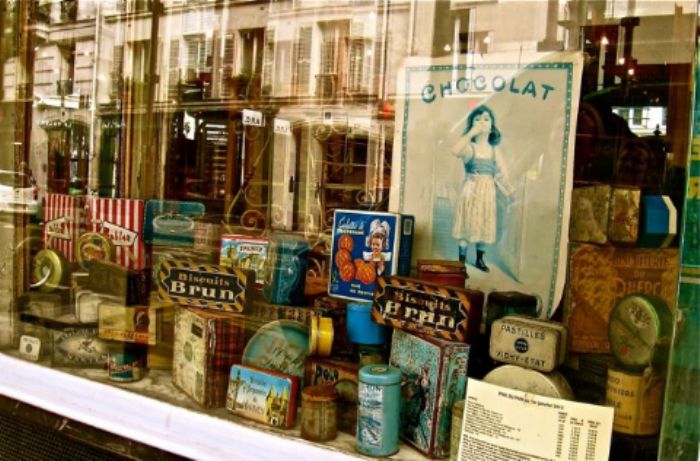
A shop window near the Canal St. Martin

A shop window near the Canal St. Martin

Time for a pastry from that bakery, stuffed with apple purée. Then we decided to double back to Sèvres-Babylone on the metro and catch Woody Allen’s new film, ‘Blue Jasmine’, which was on at the Japanese Pagoda.

Instead of trudging back to the cacophony of République, we hopped on the train at Goncourt. I wondered whether this station’s name had anything to do with ‘le prix Goncourt’.

It’s not in a fashionable area. However, the literary prize is very prestigious.

I am flagging but a welcome pot of tea, sitting by the dragon in the garden of ‘la Pagode Japonaise’ on the rue Babylone, is a lifesaver. We’ve bought tickets for this special cinema.

‘Blue Jasmine’ is shown in a salon where leopards, snakes, dragons and exotic scenes in gold leaf and rich oriental colours cover the walls and ceiling. We sink back into the red plush chairs in anticipation.

Tea at the 'pagode japonaise' with the dragon ...

Tea at the ‘pagode japonaise’ with the dragon …

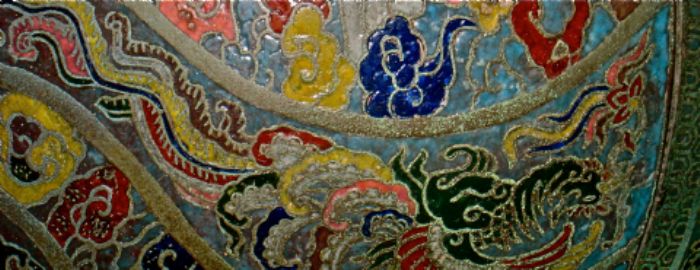
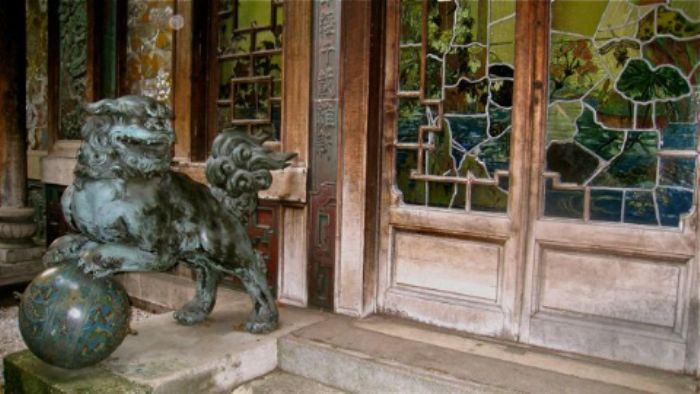
The intricate art of cloisonné

The intricate art of cloisonné

Cloisonné is an intricate and decorative ancient technique, used first in the Byzantine Empire and spreading out to China and later to mediaeval Europe. It uses wire made of copper or silver to enclose enamels of different colours. Objects decorated like this are still very popular and can command vast prices today.

We couldn’t have seen ‘Blue Jasmine’ in a more wonderful setting. Double fabulosity. La Pagode was built in 1896 as a gift to the area from M. Morin, who owned ‘Le Bon Marché’. Once a dance hall, it’s now a well attended, independent cinema.

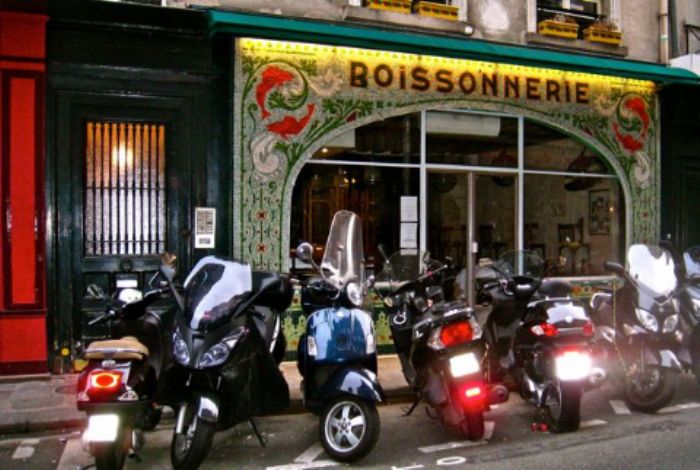
Afterwards, we had dinner at ‘La Boissonerie’, near the hotel. It specialises in fish dishes and was packed to the gills, but we only had to wait fifteen minutes to get a table. A great choice with a buzzy, upbeat ambiance.

La Boissonerie, rue de Seine

La Boissonerie, rue de Seine

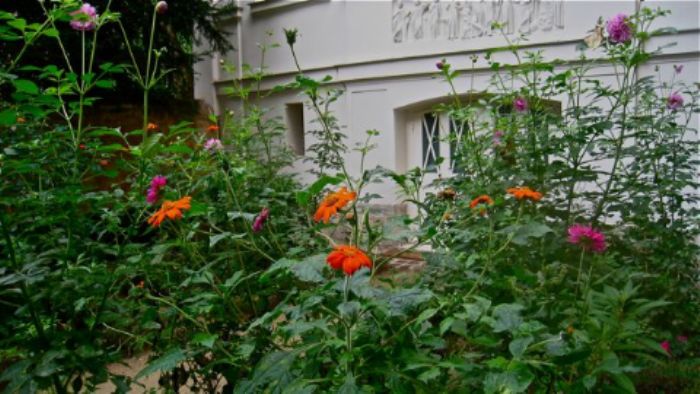
Rain hovered next morning, so we slipped around the corner to the Musée Delacroix. It’s a special place with a hidden garden and feeling of intimacy. Small and contemplative.

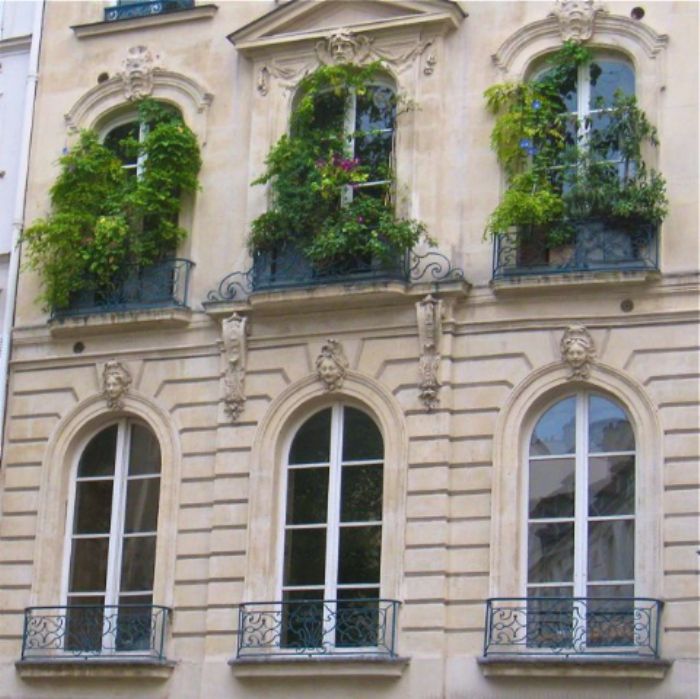
Feral window boxes, rue de Seine

Feral window boxes, rue de Seine

Delacroix's secret garden

Delacroix’s secret garden

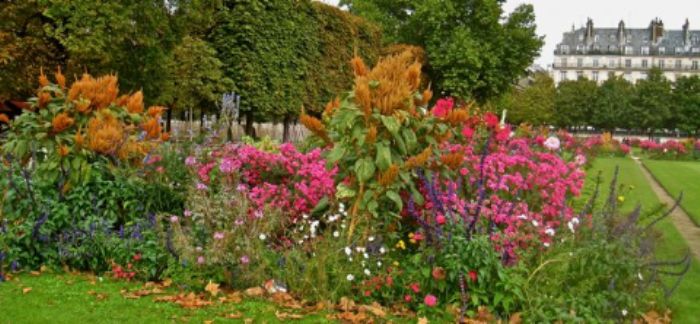
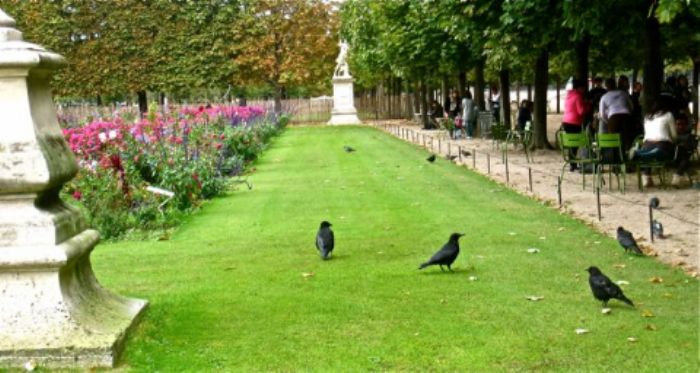
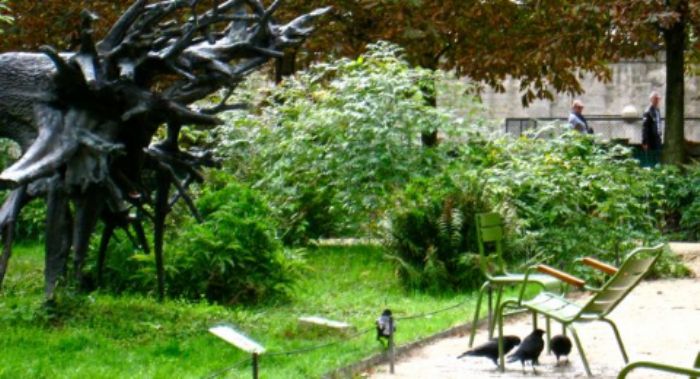
A quick sprint to the shop which sells sardines in pretty packaging, then it was back across the river to Finkelsteins to buy boreks for the train journey to London. We chose the spinach and the cheese. The threat of rain had passed and so we made our way through the Tuileries gardens, where banks of fabulous flowers were still in bloom.

Sumptuous flowerbeds at Les Tuileries ...

Sumptuous flowerbeds at Les Tuileries …

A herbaceous border to envy in Les Tuileries

A herbaceous border to envy in Les Tuileries

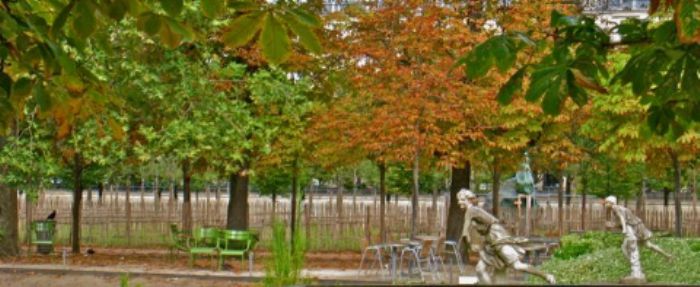
Speeding towards Autumn - Les Tuileries

Speeding towards Autumn – Les Tuileries

Les Tuileries - a confabulation of crows...

Les Tuileries – a confabulation of crows…

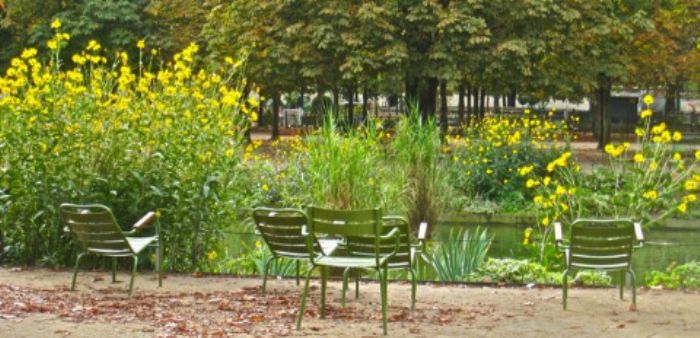
Les Tuileries - symphony in yellow and green

Les Tuileries – symphony in yellow and green

The new Frieda Kahlo exhibition at the Orangerie had queues to the horizon, so we took the passerelle across the Seine, passed the Musée d’Orsay and made our way down the Rue de Lille. Lunch at ‘Le Comptoir’ at the carrefour Odéon was next in our sights. Before that, we passed the famous triumvirate of ‘Les Deux Magots’, Café Flore’ and ‘Brasserie Lipp’ on the Boulevard St. Germain – not forgetting the mad waiter from time past at ‘Le Petit St. Benoît’ with its red check tables, just around the corner.

Study in brown - Rue de Lille

Study in brown – Rue de Lille

Life behind the blue doors ...

Life behind the blue doors …

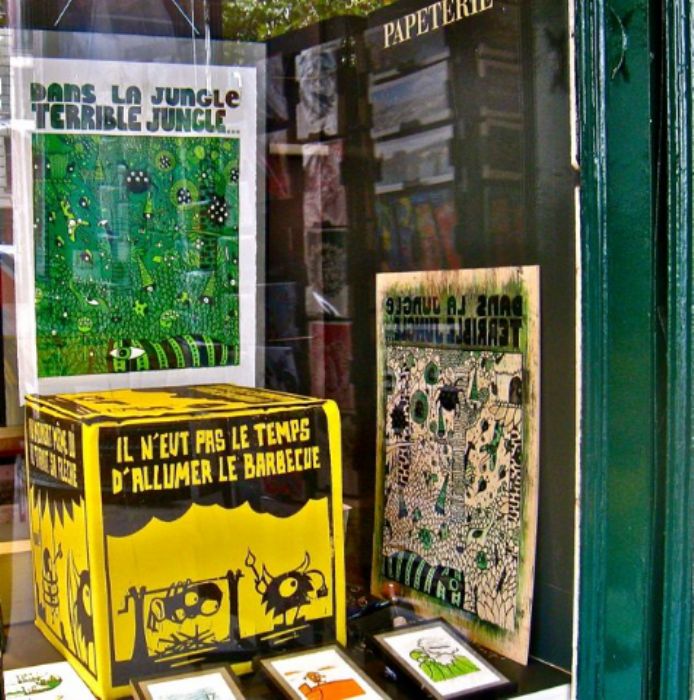
A favourite 'Papeterie' near Café Flore ...

A favourite ‘Papeterie’ near Café Flore …

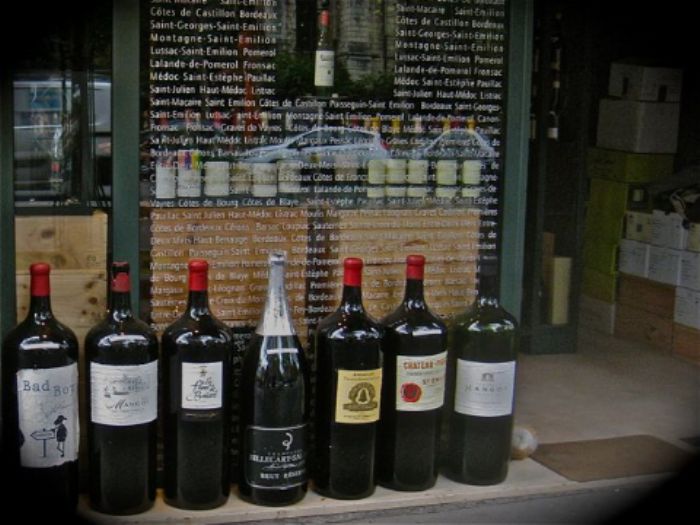
Les vins de France  ...

Les vins de France …

Lunch at 'Le Comptoir'  -  we'll be back!

Lunch at ‘Le Comptoir’ – we’ll be back!

No metro strike after all but our cases were heavy, so we took a taxi back to the Gare du Nord. As we waited in the courtyard, the rain finally broke through in earnest, so the twenty euros was well spent.

Note; Le Prix Goncourt was set up by the brothers Goncourt – Edmond (1822-1896) and Jules (1830-1870). They first saw themselves as painters but changed to writing together.

They wrote a long journal, describing the literary and social life of the times, started in 1851. They were friends of Flaubert and also wrote novels together, one about the maid in their household who, to their surprise, led a double life.

After Edmond’s death, their estate was used to set up the Academy Goncourt, which administers the Prix Goncourt for literature. This has been awarded since 1903. The equivalent in the U.K. would be the Man-Booker prize.

END

Posted in Uncategorized | Comments closed

Bloody cabbage

Tonight it was supper for one.

There were a few new potatoes left over from dinner last night. I fried two red onions with garlic and a courgette, chopped fine, with the potatoes.

Then I cut up half a large cabbage to steam it. Supper for oneself means not having to worry about anyone elses’s taste! I love cabbage, sometimes topped with a fried egg and black pepper. It’s my standby for a solitary supper.

Meanwhile, I was watching an old Poirot on ITV3, using my new sharp knife to slice the cabbage. But I didn’t pay enough attention to what I was doing on the chopping board. The pain of slicing through the top of my finger was intense and excruciating. The amount of blood pouring out all over the cabbage was reminiscent of the ‘Texas Chain Saw Massacre’. And it refused to stop.

I began to feel dizzy and faint. I made myself go over to the sink and put on the cold tap. I watched a red stream flushing down the hypnotic plughole. Eventually I put some kitchen roll tenderly around my damaged finger and held it tight.

No point in watching Poirot now – I’d lost the plot on all fronts. And John was away, eating dinner elsewhere. I wiped up blood from the floor. The house was eerily silent.

Something told me I needed to eat.

When you get a small cut, your natural reaction is to suck it. I do, anyway. There was a lot more blood than that on the cabbage. A great deal more. Red and green are complementary colours.

Although it made me feel slightly queasy, I put the bloody cabbage in the steamer.

It was common sense really, I told myself. The blood was my own. I had no diseases I knew of, it was fresh and it was protein, so why shouldn’t I reclaim it?

The cabbage tasted only of good, sweet greens. The fried potato melée was a perfect match. The food restored my equilibrium.

Most people were rather horrified when I told them about recycling my blood. ‘Eating your own blood – ugh’. I admit it does stir up some sort of visceral repulsion. But why should this be?

I won’t be adding this to my list of favourite recipes but – reporting back – I’m none the worse for it. And I’m not showing any cannibalistic tendencies to date.

A bloody beautiful cabbage ...

A bloody beautiful cabbage …

‘Will all great Neptune’s ocean wash this blood

Clean from my hand? No, this my hand will rather

The multitudinous seas incarnadine,

Making the green one red.’

Shakespeare – Macbeth Act 2, scene 2

END

Posted in Uncategorized | Comments closed

What I saw in the park …

The mellow warmth of a late September sun, which somehow illuminates everything in such sharp detail. There’s the feeling of time slowing down, encouraging a companionable silence. We made our way through the spinney, then down past the small pond, before climbing up the bracken covered slope towards Pen Ponds.

Speckled wood butterfly - Richmond Park

Speckled wood butterfly – Richmond Park

In the long grass we noticed small groups of mushrooms on each side of the path.

Autumn - splendour in the grassAutumn – splendour in the grass
Mushroom or toadstool?Mushroom or toadstool?

I think this one may be a toadstool. Best not to eat either of them. In Switzerland, there are days designated for mushroom picking and the local chemist knows which varieties are safe to eat. If you don’t visit the pharmacy to check and then die, I expect it’s counted as your own fault! Not that you would be around to complain …

Dappled sunlight ...Dappled sunlight …
Golden days for a man on his bicycle ...  part of the landscape ...Golden days for a man on his bicycle … part of the landscape …
The water was very blue as we passed Pen Ponds, reflecting the sky. On our left there were two groups of deer and the tension between the stags was palpable. We kept out of their way but passed this small fawn, seemingly unaware of the power broking going on near at hand.
The calm before the storm ...The calm before the storm …
Retracing our steps to the Sheen Gate under a blue sky with baby, white clouds and a procession of large aeroplanes.
END

Posted in Uncategorized | Comments closed

The shock of the new

The new complex of Kings Cross, St. Pancras and the Eurostar is a marvellous transformation. Industrial Victoriana heralded a new, wealthy age for Britain but also one where pollution belched from chimneys, covering buildings in coal fired black grime and contributing to poor health, as people were drawn to cities for work. Beautiful, high quality buildings like St. Pancras are now coming into their own, having been cleaned up inside and out.

I was unaware of what had been going on just north of Kings Cross until we went to Bruno Loubet’s new restaurant, ‘The Grain Store’ in Granary Square. What had been a dark and dirty wasteland of old railway sidings and derelict warehouses – a place suited only for gangster film locations – is now full of light and space. It’s almost like a black hole turning inside out into a white gusher – or coming out of a long tunnel through the mountains into a sun filled place of extraordinary beauty.

The restaurant is housed in a refurbished warehouse, which used to store wheat from Lincolnshire for London’s bakeries – hence ‘The Grain Store’. The old canal, where barges used to unload their goods, moments from Kings Cross, is an added asset to the square itself, with its myriad fountains.

Granary Square 1Granary Square 1
Deckchairs and fountains in Granary SquareDeckchairs and fountains in Granary Square
Cityscape - Granary Square - moments from Kings Cross, St. Pancras and the EurostarCityscape – Granary Square – moments from Kings Cross, St. Pancras and the Eurostar
Old warehouse, ripe for renovationOld warehouse, ripe for renovation

The manager of the restaurant came over and told us about the history of the place and why Bruno Loubet had decided to base his new restaurant here. We ended up with a bottle of English champagne, which was excellent and I felt we were toasting Granary Square, along with Bruno Loubet’s entrepreneurial and culinary skills, as well as our personal reason for coming here. There is a previous entry in the journal about BL’s other restaurant in Farringdon. He is much to be admired on many fronts!

The Grain Store  -  a delicious dishThe Grain Store – a delicious dish

And then the four of us walked down the new pedestrian way back to Kings Cross, our stomachs replete and our spirits uplifted. I go through phases both of love and loathing for London. I loved it today.

Walking back to Kings Cross ...Walking back to Kings Cross …

END

Posted in Uncategorized | Comments closed

Peacocks, Pigeons and Sweet Peas

Butterflies have been few and far between in our London garden this year. A few cabbage whites, which have the disadvantage of ruining your cabbages but otherwise, only a small blue one from time to time. They are too fast to photograph. Just a flash against the blue of the sky and they’re gone.

Two peacock butterflies out of 21!

Two peacock butterflies out of 21!

We were down for a day in the Cotswolds. There’s a huge buddleia bush at the gate to the house and I counted twenty one peacock butterflies on it. Buddleia is known commonly as the ‘butterfly bush’ but mine doesn’t seem to have the same allure! Still, it’s good to know that the continuing late summer has helped the butterfly population to recover.

The butterfly bush lives up to its name

The butterfly bush lives up to its name

Sweet peas are one of my favourite ever summer flowers, especially the perfumed ones. Even the most expensive perfumes can’t reproduce that fragrance. Here they are sitting by the back door in an odd combination with leeks. We got to take the leeks from the garden home with us.

Odd companions ...

Odd companions …

A collared dove making the most of the heatwave ...

A collared dove making the most of the heatwave …

On a beautiful, warm, summer’s day in the Cotswolds.

Posted in Uncategorized | Comments closed

Hit by a late Heatwave

The promise of sitting outside under sunny blue skies and the need for a sunshade suddenly translated into real time in the first week of July.

Although I do long for a stretch of warm and clement weather, I flop over like a rag doll when the barometer climbs above 26 degrees. My brain overheats and I am no good for anything. I couldn’t live happily in a country that was both very hot and humid, as I am without energy, drive, curiosity … a sort of stupor paralyses me, sweat drips constantly down my face. Bill Bryson (one of my favourite writers) calls this ‘perspiration incontinence’. I wish I had thought of this phrase – it’s just so perfect.

John loves the heat but feels the cold. He has ancestors from Mesopotamia, mine are Nordic.

Having said that, it was great to be able to enjoy sitting out in the garden, surrounded by flowers. There seem to have been fewer insects this year. Even though wasps can be tiresome, I missed them buzzing around with their beady eyes, visiting my lunch, sipping at my glass of cider, like old ladies fussing. And they do, rapier like, kill many garden pests. I expect some old ladies have done the same with hat pins …

Last year, we had scores of ladybirds on the hibiscus. I have only seen two to date, and they are peely wally orange rather than carmine red. But it’s good to see a huge variety of bees on the blue thistles, which have spread to twice the size this year. A gardening friend has dug hers up as an invasive species – but the bees love them, so they have a stay of execution here.

Saturday lunchtime ...

Saturday lunchtime …

Sunny weather for Barnes fair 2013

Sunny weather for Barnes fair 2013

Exotica opposite Barnes pond

Exotica opposite Barnes pond

Exploring a small path on the Common

Exploring a small path on the Common

Moorhen scouting around Barnes Pond ...

Moorhen scouting around Barnes Pond …

Island - Barnes Pond - summer 2013

Island – Barnes Pond – summer 2013

Summer afternoon - Barnes Pond

Summer afternoon – Barnes Pond

OUT AND ABOUT

I always go to the Summer Exhibition at the Royal Academy. This year it was middling. Last year was better. But it keeps me ‘au fait’ with the lie of the land. Although a lot of people complain about it, I think it’s good to have a mix of styles and talent. And you are free to decide for yourself what you like – without knowing who did what, until you check the listings for the artist, price etc. I always look forward to finding a ‘gem’! One was a print by Susie Perring called ‘Ripple Effect’, which is still one of my favourite buys ever. It gives me a splash of energy every time I look at it. Thank you, Susie.

A painterly pigeon cooling down at the RA ...

A painterly pigeon cooling down at the RA …

Relaxing outside the RA ...

Relaxing outside the RA …

Bowling along Piccadilly ...

Bowling along Piccadilly …

A favourite actor outside Hatchards bookshop on Piccadilly ...

A favourite actor outside Hatchards bookshop on Piccadilly …

This is the second time I have seen Bill Nighy close at hand. If I see him a third time, I shall pluck up courage and say ‘hello’ !

Neal's Yard, Covent Garden - heatwave August 2013

Neal’s Yard, Covent Garden – heatwave August 2013

The BP Portrait Award exhibition was excellent this year but I didn’t agree at all with the judges’ verdict. Visitors are allowed to vote for their favourite portrait online at the gallery. The one I liked best was a self portrait by Daniela Astoni. It came second with the visitor vote. I liked the one that came first too but it had a slightly travel advertising quality about it, whereas the second and third (also a favourite of mine but not to put on the wall) were, to my mind, more painterly. I was glad to see that all the paintings collected at least one vote from the visitors. John liked Daniela Astoni’s self portrait very much too, so I ended up buying a print of it, which they sold in the National Portrait Gallery shop.

I went to see the Vermeer + Music exhibition at The National Gallery. This concentrated on his ‘musical’ paintings – ‘A Young Woman seated at the Virginals’, ‘The Music Lesson’, ‘Guitar Player’, ‘Woman with a Lute’. The Academy of Ancient Music sent a small orchestra, who played seventeenth century music in one of the rooms. It was evocative of the time Vermeer painted and maybe of how he felt about the women who played these instruments. There are stories behind these paintings.

Although ‘The Girl with a Pearl Earring’ (Vermeer’s most popular painting today), wasn’t in the exhibition, she came to mind as I wandered round. I very much enjoyed the historical novel of the same name, written by Tracy Chevalier in 1999, which was made into an excellent film, starring Colin Firth as Vermeer, Scarlett Johansson as the girl, Griet, and Cillian Murphy as Pieter, the amorous butcher’s boy. I am drawn to Griet’s simplicity and the mystery of her gaze, which one can’t help but think is unrequited love for the painter. That one glowing pearl earring is symbolic too – she is forever holding a candle for a love she cannot have. I noticed some pearl necklaces in the shop on the way out. Somehow, they seemed to have that special glow too and I was tempted to buy one. I wear it a lot.

Vermeer always reminds me of one of his contemporaries, Carel Fabritius, who worked in Rembrandt’s studio for two years and later moved to Delft. Vermeer knew Fabritius and was influenced by him. Sadly, Fabritius was killed aged only thirty-two. If he had lived he may very well have had his name alongside those Dutch painters we celebrate today. But there was a huge explosion of the Delft gunpowder magazine, which destroyed a quarter of the city along with Fabritius and his workshop.

Very few of his paintings survived. The ones I know and love are ‘A View of Delft’, where he experiments with perspective, a self portrait done in the year of his death and ‘The Goldfinch’. This last painting is often mentioned for its simplicity and clarity and, for me, the transitory nature of beauty and life. It holds my breath, just like ‘The Girl with a Pearl Earring’. I was interested to see that Donna Tartt’s new book is called ‘The Goldfinch’ and a picture of the bird is on the jacket. She must have been drawn to this painting too.

As I left the gallery, I noticed the strutting Gallic cock on its plinth, fixing Nelson with a beady eye in Trafalgar Square.

Le coq bleu français observe Nelson aux yeux en boutons de bottines  ...  Sacré bleu!

Le coq bleu français observe Nelson aux yeux en boutons de bottines … Sacré bleu!

BIT OF A MELTDOWN

Can I really be longing for rainclouds? I am so hot I want to be a nudist. Lots of the neighbours are on holiday. My brain is addled and I begin to see flying saucers down by the summerhouse.

Addled brain gazing at the sky

Addled brain gazing at the sky

Just a very small glass of wine ...

Just a very small glass of wine …

The overheated brain

The overheated brain

Brainclouding  -  I see a flying saucer at the bottom of the garden ...

Brainclouding – I see a flying saucer at the bottom of the garden …

Aaargh!  Flying saucer coming closer ...

Aaargh! Flying saucer coming closer …

I felt the aliens were watching me intently. Will I be spirited away? Oh dear, I am too hot to panic. Later, I went inside and read ‘The Humans’ by Matt Haig – again! Much recommended.

END

Posted in Uncategorized | Comments closed

Glamour

Back in central London after our rural rides, I found myself walking up Bond Street, surrounded by dinosaurs. Am I getting into the dinosaur era myself now? There are some wonderful clothes around, which I am obviously too old to even consider. But I’m still alive enough to appreciate them on other leggy, glamorous models, tottering along the sidewalk.

Hey you, that's my handbag!

Hey you, that’s my handbag!

Jurassic Joy  -  head in the clouds ...

Jurassic Joy – head in the clouds …

In the evening, we were invited to a party in Notting Hill with no dinosaurs … only the international jet set. We came home on the number 9 bus via Kensington …

Party time in Notting Hill ...

Party time in Notting Hill …

in the company of ‘not the international jet set’ – however, you never know Who’s Who these days … and that straw hat certainly looks like a one-off, unique piece!

Company on the bus ...

Company on the bus …

END

Posted in Uncategorized | Comments closed

Driving down to Devon and Dorset

We set off in driving rain. Just out of London on the M4 there’s a spooky petrol station, where I always feel caught up in a time warp. It’s blocked off by trees on all sides, eerily silent and never busy. The sort of place where time stands still – in a creepy sort of way – where you might suddenly find yourself lost in a different dimension with no voice and no way of getting back. But the petrol costs the same as everywhere else …

Heavy lorry spray and boy racers to contend with en route but the deep velvet tones of Jeff Lynne soothed my stress levels. We finally turned off on to the M5 and made a welcome stop at Buckfast Abbey, on the edge of Dartmoor. One of the monks, Brother Adam, kept bees and made honey here for over seventy years. Now he has gone and we were told that the abbey didn’t have beehives any more. A sad state of affairs, even more so given the alarming loss of bees worldwide at the moment.

After a hot and refreshing cup of coffee, we bought some honey from Exmoor bees. There is a specially good ‘monastery’ shop which sells products made by monks from abbeys all over Europe. Worth investigating – it’s in addition to the other gift shop at the entrance.

A decapitated stone head lay casually asleep on the grass as we went into the abbey grounds. Rather reminiscent of Easter Island – but a squashed version … I wonder where he came from because he doesn’t resemble an abbot – more like the man in Berwick Street market who used to sell me delicious pineapples.
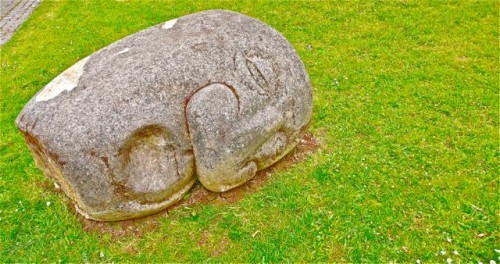
The Sleeper

The Sleeper

There is a beautiful horse chestnut nearby, now in all its candelabra glory. It made me think how much we take trees in the landscape for granted. I hope it doesn’t have the disease that many of the horse chestnuts in London have succumbed to. Both bees and trees are suffering and we need to take note and make changes now in our selfish lifestyles if we ourselves, as a species, are to survive. We are so interdependent on the physical world – why are we so destructive of it?

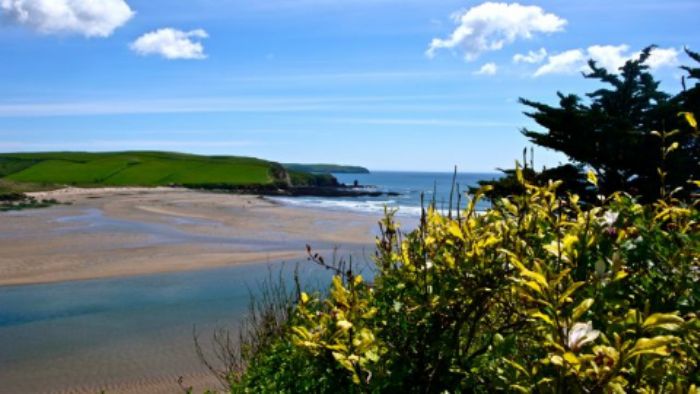
As we left the M5, the roads became more and more narrow – we were squeezing between high hedges bursting with colourful wild flowers on either side. This reminded me of childhood holidays and the rising excitement of arriving somewhere new by the sea. We weren’t disappointed. The Henley Hotel is on a cliff top and we were welcomed with tea and cake in the garden. Breezy, grey clouds turning to white, sea air and snatches of blue sky. Energised again after the long drive, we walked down the steep hill to the sea and Burgh Island.
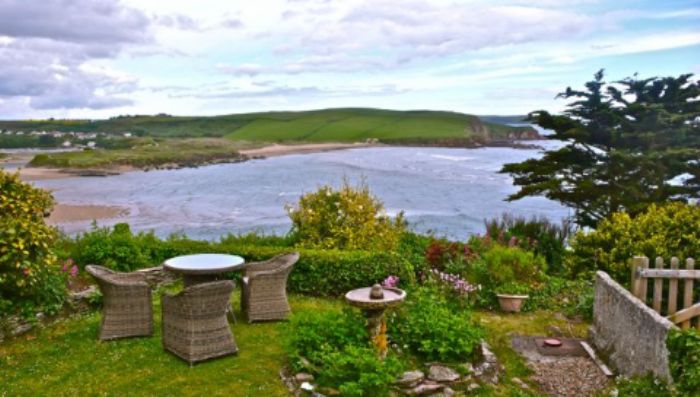
Henley hotel - cliff top garden

Henley hotel – cliff top garden

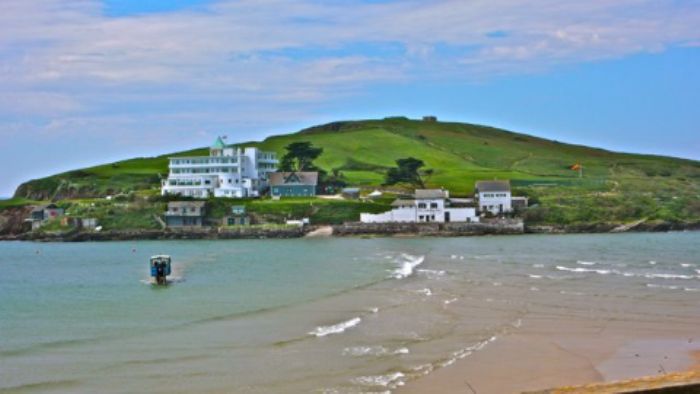
The tide was out, which meant we could walk across the sand to the island (of Agatha Christie fame). She based her mystery ‘Evil Under the Sun’ here. There’s a large art deco hotel, fenced off in its own grounds, covering almost half the island. It was here that Hercule Poirot solved a murder whilst on holiday. I recognised it immediately from the TV production. Agatha Christie actually lived a little way up the coast in a big white house called ‘Greenways’, overlooking the estuary near Salcombe, where the river Dart meets the sea.

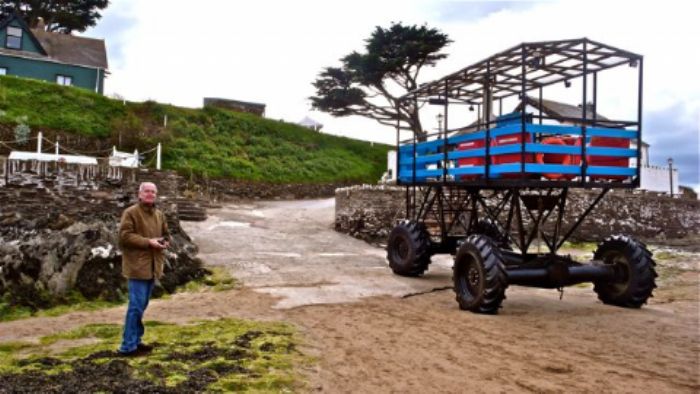
At high tide, a sea tractor conveys the guests to and from the mainland. It was to be the best week of the summer so far, although we didn’t know that then. Evening sun silhouetting the surfers, fresh fish for dinner, a lighthouse winking on the horizon as the sea disappeared into the twilight. And ‘The Humans’ by Matt Haig waiting patiently in my case to be read. I wasn’t aware then of this added treat that lay in store …
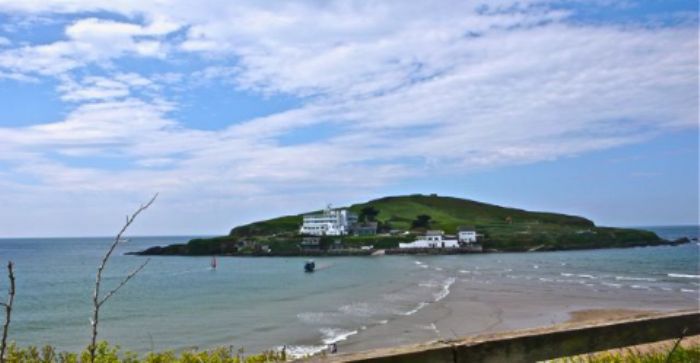
Incoming tide at Burgh Island - with sea tractor and windsurfer ...

Incoming tide at Burgh Island – with sea tractor and windsurfer …
Closer ...

Closer …

John meets the sea tractor at low tide ...

John meets the sea tractor at low tide …
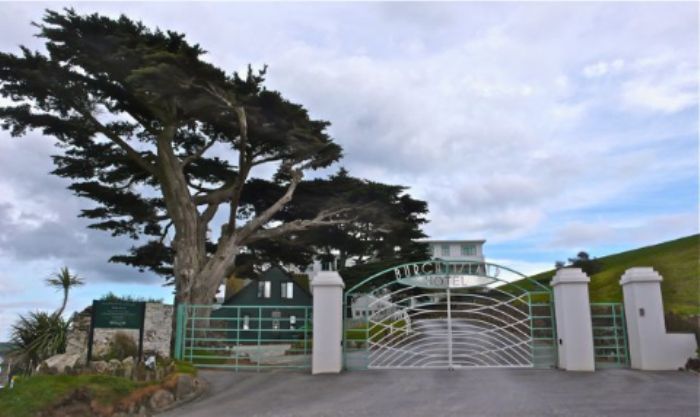
Entrance to Burgh Island hotel - guests only!

Entrance to Burgh Island hotel – guests only!
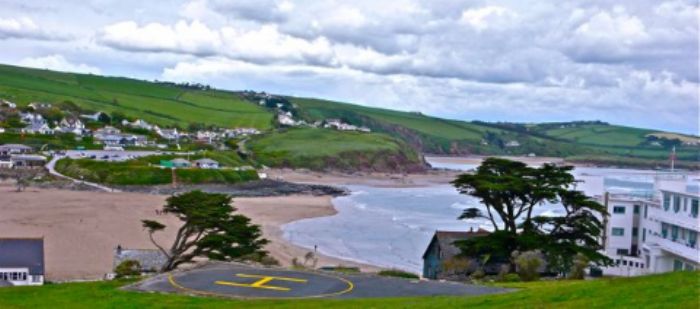
Arriving by helicopter - Burgh Island hotel

Arriving by helicopter – Burgh Island hotel
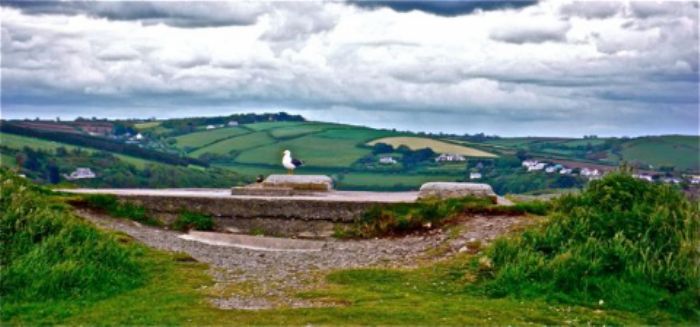
King of the castle - Burgh Island

King of the castle – Burgh Island

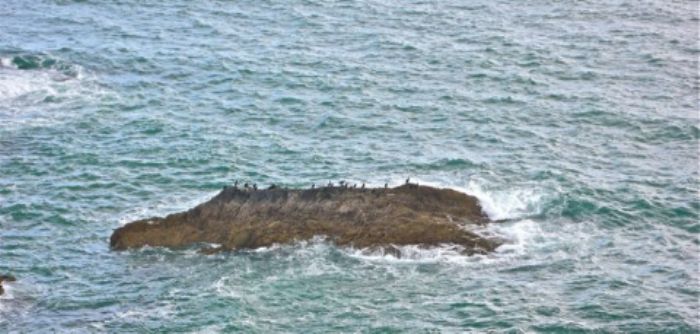
A sea monster shaped rock beloved by cormorants - Burgh Island

A sea monster shaped rock beloved by cormorants – Burgh Island
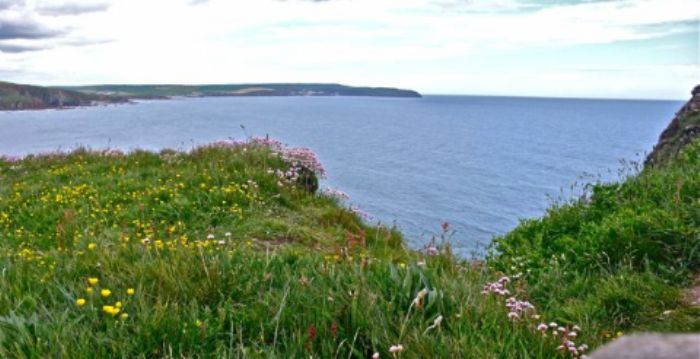
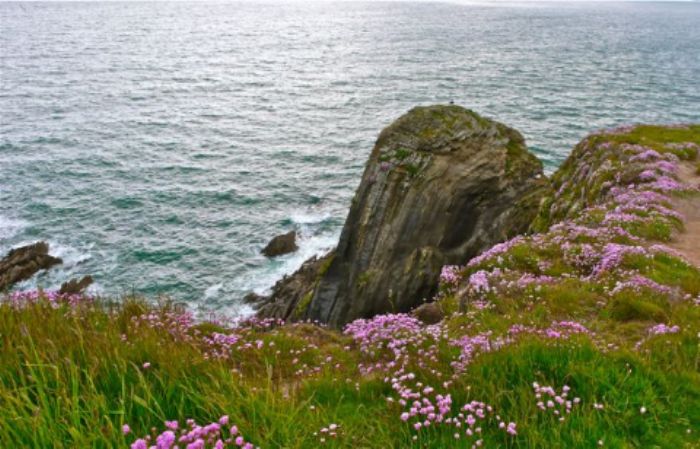
Sea thrift at the top of Burgh Island ...

Sea thrift at the top of Burgh Island …
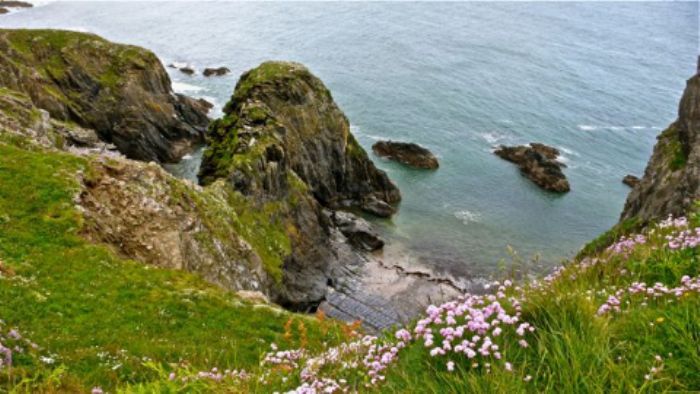
Secret unreachable coves - Burgh Island

Secret unreachable coves – Burgh Island

As we walked over the cliff tops on the sea side of the island we were rewarded with more and more blue sky as a warm wind dissolved the heavy rolls of grey. And no bodies lying in secret coves.
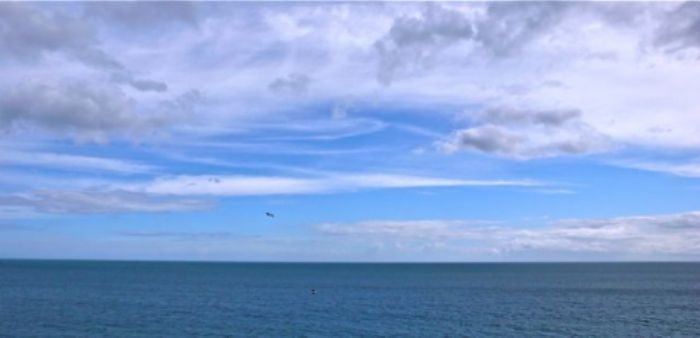
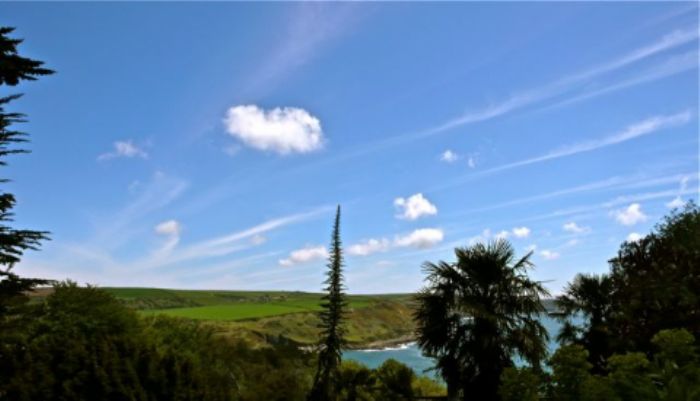
Blue sky over Burgh Island ...

Blue sky over Burgh Island …

Pinks and greens - summer by the sea ...

Pinks and greens – summer by the sea …
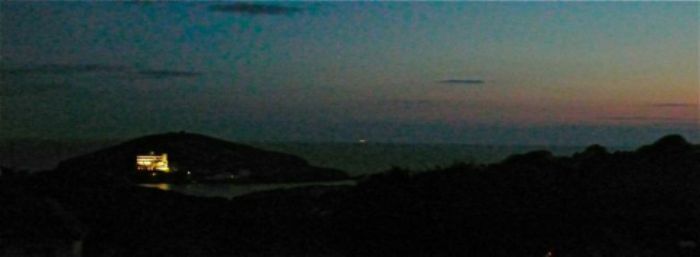
Our 'room with a view' at bedtime ...

Our ‘room with a view’ at bedtime …

Note the light on the far horizon … through the binoculars, this seemed to be a brightly illuminated enormous ship. A ‘Marie Celeste’ mystery …

The hotel had only half a dozen rooms. There were three couples having breakfast the next morning. I identified them by the newspapers laid out at each table. FT/Times, The Daily Telegraph and The Daily Mail. The DTs were from London (I eavesdropped!) and kept to themselves as if they were rather special compared to everyone else. They talked ‘importantly’ in low voices and didn’t make eye contact. On the table next to us was a stocky man in his sixties with a big smile, sparkly blue eyes and a bluff manner. His partner was quite a lot younger and they obviously delighted in one another’s company. It didn’t take him long to lean over for a chat.

Roger and Gemma had been ballroom dancing in Torquay. He told me he had lost his wife a couple of years ago and met Gemma at dancing class. They did a lot of coast walking and told us how to climb down the steep cliff at the back of the hotel. Roger obviously still had a great zest for life – he and Gemma drove off with a flourish to Dawlish in his sparkly blue Porsche for another ballroom dancing soirée. He kindly left me his cliff walks map.

We could have stayed put and clambered up and down the rickety steps on the cliff face but we decided to explore further afield and drove to Overbeck’s garden, which is on another cliff top near Salcombe. Twisty, tiny roads, big drops to the shoreline and cars trundling large boats, trying to push us into oblivion. The road up to the garden was steep and zig zagged. And we actually had to park on the edge of the drop. This garden had to be good – and it was.
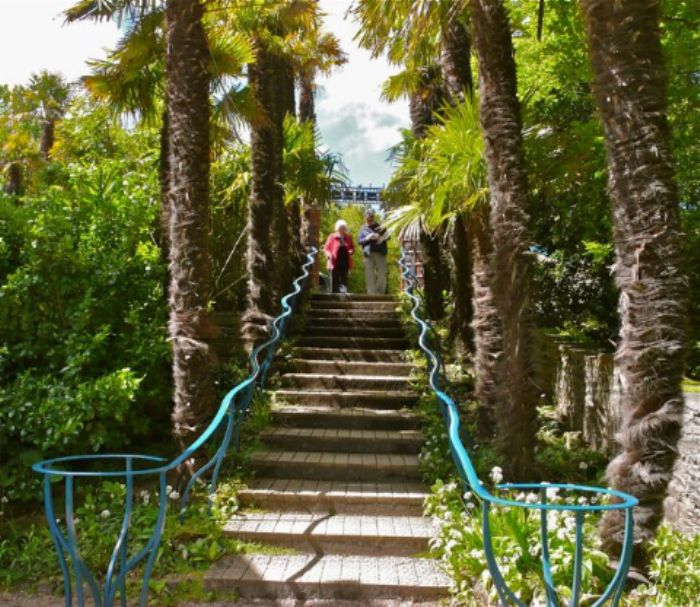
Entrance to Overbeck's- Devon

Entrance to Overbeck’s- Devon

Overbeck’s garden was bequeathed to The National Trust by the last private owner – Otto Overbeck (1860 – 1937). He was a scientist and inventor and a great collector. See John’s blog to find a photo of the Polyphon – an enormous musical box which uses giant metal disks with coded punched holes to make music of the time.

Like the Victorians, Overbeck had a fascination with the natural world and collected lots of insects and butterflies. Apparently, ‘beetling’ was a very popular pastime in the Victorian era.

A. A. Milne (1882 – 1956) wrote a poem about a beetle, which I used to know off by heart. It encouraged me to do the same thing as a child but with a ladybird – which also – happily – escaped.

‘I found a little beetle; so that Beetle was its name,
And I called him Alexander and he answered just the same,
I put him in a match-box and I kept him all the day …
And Nanny let my beetle out,
Yes, Nanny let my beetle out,
She went and let my beetle out,
And Beetle ran away.
She said she didn’t mean it and I never said she did,
She said she wanted matches and she just took off the lid,
She said that she was sorry, but it’s difficult to catch
An excited sort of beetle you’ve mistaken for a match.

If you want to hear more, look up ‘alexander beetle poem’ …
There is also an ‘electrical rejuvenator’ machine in the house – invented by Overbeck, which he claimed would help stave off the ageing process. It helped to make his fortune. He died aged 77.
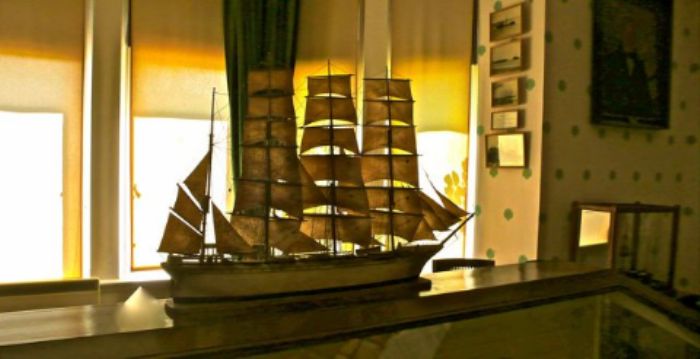
Overbeck's house and garden - The Maritime Room

Overbeck’s house and garden – The Maritime Room
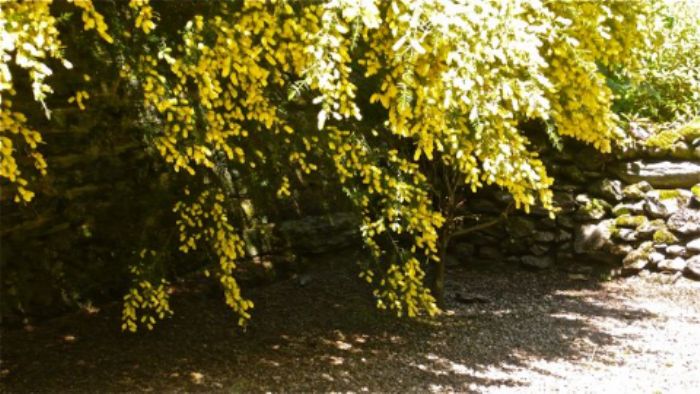
Snoozing in the sun ...

Snoozing in the sun …

During WW1, the Red Cross were able to use the house as a convalescent home for wounded soldiers. There are photos which show them sitting outside in the sun surrounded by kindly nurses. There was no record of any deaths. Fifteen of the soldiers ended up marrying Devon girls. Today the lawn is full of children, playing ball. The sun is still shining.
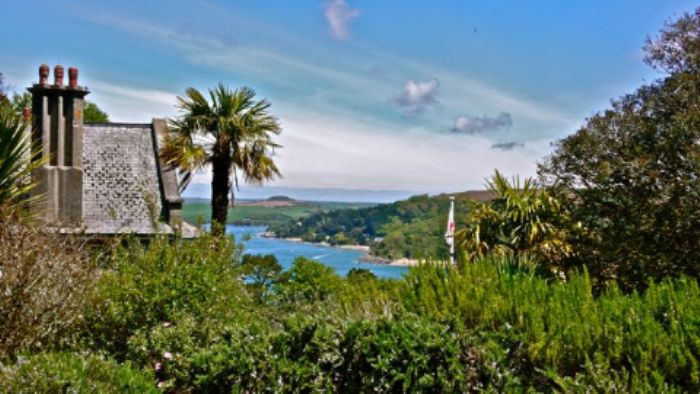
View of the bay from Overbeck's garden

View of the bay from Overbeck’s garden

There is also a Tea Room, which proffered welcome refreshment. We sat by the large window, overlooking Salcombe and the estuary and watched the yachts, which looked like white feathers floating on the blue sea, reflecting the white puffs of cloud above. I had a ginger beer with my sandwich which perked me up. John bought a bottle of lemonade for an old man standing in the queue behind us. He perked up too.

Outside, we passed swathes of ransoms (wild garlic) under the trees. They have a pervasive smell which seems to get under your skin – not quite Chanel No. 5 – but very ‘natural’. Some older relative once commented on me when I first met John – ‘She’s very natural – is she foreign’?! Another great-aunt compared me to ‘The Birth of Venus’ painting by Botticelli … Oh dear, it’s often said that youth is wasted on the young but one can’t do much about it later …
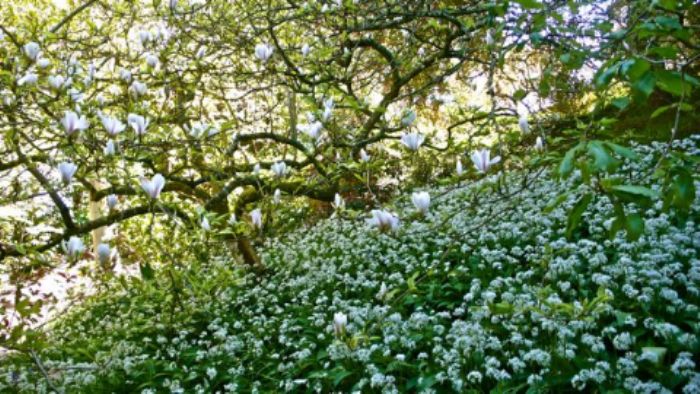
Magnolia and ransoms at Overbeck's garden

Magnolia and ransoms at Overbeck’s garden

‘Shall I compare thee to a summer’s day?
Thou art more lovely and more temperate:
Rough winds do shake the darling buds of May,
And summer’s lease hath all too short a date
from Sonnet 18, William Shakespeare.

The sonnet carries on though in optimistic mood and I felt the same as we explored the gardens, which are beautifully terraced with glorious views of the sea.

A 'natural' rocket ...

A ‘natural’ rocket …

Summer sky at Overbeck's garden

Summer sky at Overbeck’s garden

A sunlit corner ...

A sunlit corner …

We walked along terraces up high and down low and then through the trees until we came to the edge of the property. It was mid-afternoon, hot, still and silent. That time between 2pm and 4pm in the afternoon has always felt magical for me. Things have been achieved in the morning and there’s still plenty of time before evening sets in. Even if I’m in the middle of doing something, those two hours are when I feel most relaxed and at one with the world.
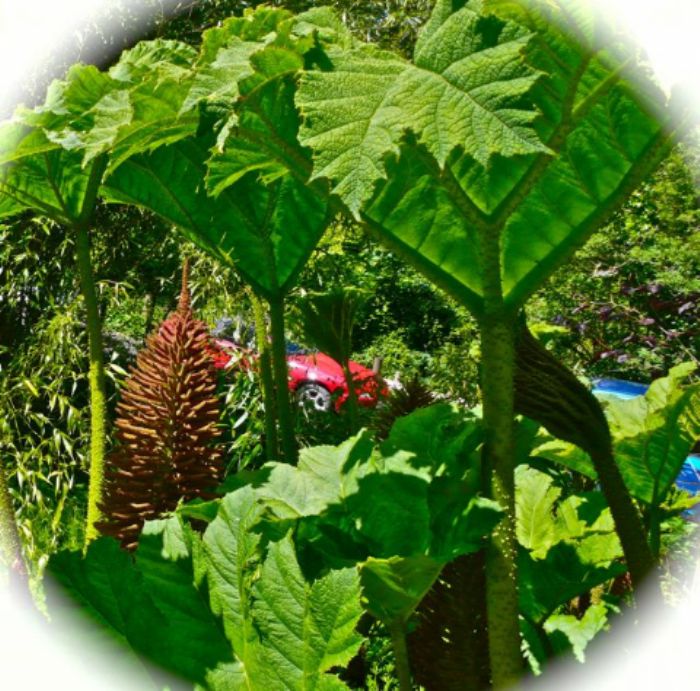
Red car in danger of being swallowed by giant gunnera ...

Red car in danger of being swallowed by giant gunnera …
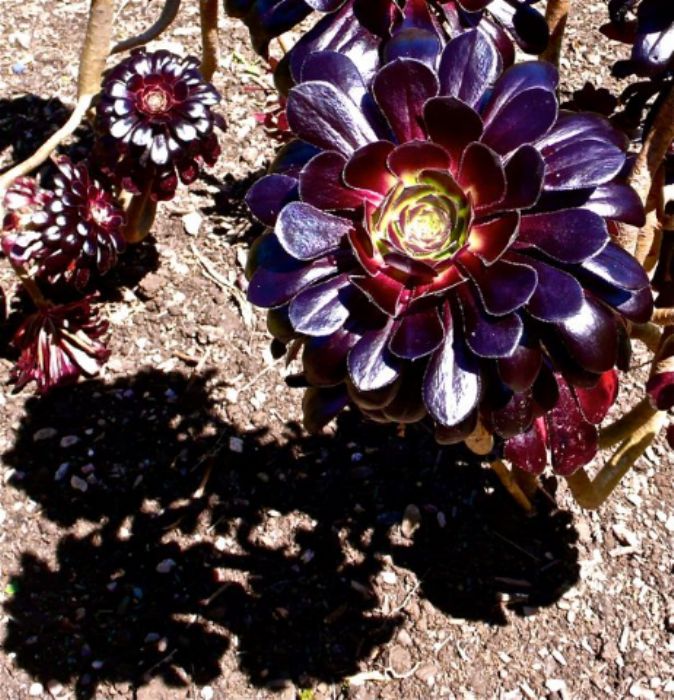
Darkly exotic ...

Darkly exotic …

Despite cold winters, exotic types of palms and plants seem to be able to survive here and it’s quite special to have such a mix. We were lucky that as the spring flowers were late we got the best of both worlds.
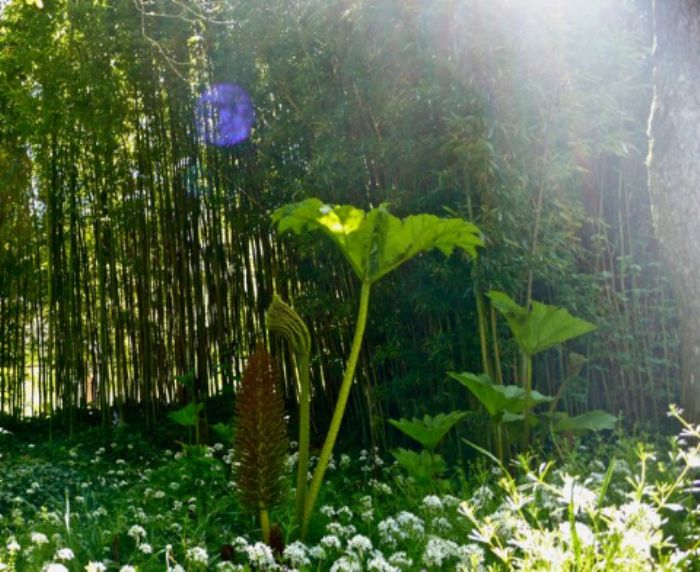
Farewell through the bamboo ...

Farewell through the bamboo …

Then it was time to make a heart stopping three point turn in the narrows and it was a relief to finally get down the winding track to South Sands – a small beach full of children, boats and dogs. There is a large car park behind the trees. I would leave the car here on another occasion and walk up the hill – what is called a ‘Devon’ mile!

Back at the hotel there was tea and cake in the garden, followed by wine and a delicious dinner. If you stay here don’t miss it! Martyn is a ‘chef’ extraordinaire. And Petra a hugely welcoming hostess. John did some writing on the book while I immersed myself in ‘The Humans’, sitting in a comfortable armchair in the window nook, looking out over the bay.

There are a lot of good writers but although I know they are good, many don’t appeal personally. I feel I would get on with Matt Haig. He sees the world in a similar way to me and I can’t put down the book! Yet I don’t want to finish it … and I sort of wish I could have written it myself. I think it will make a good film.
Sitting in the garden, reading 'The Humans' by Matt Haig ...

Sitting in the garden, reading ‘The Humans’ by Matt Haig …
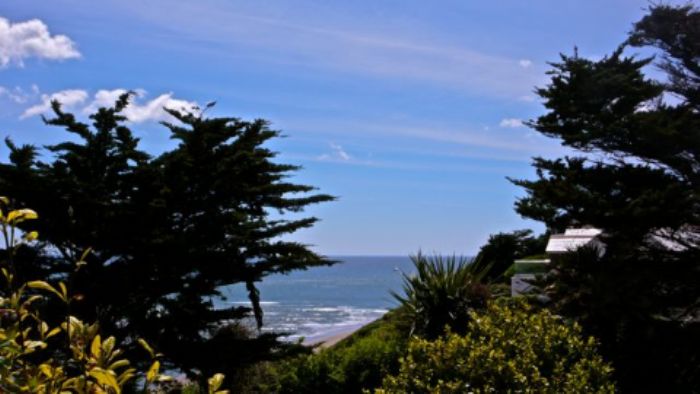
Henley Happy Hour  -  dinner on the horizon ...

Henley Happy Hour – dinner on the horizon …

On our way back yesterday I saw a signpost to Loddiswell – nearby is an Iron Age hill fort called Blackdown Rings. The new day was sunny and breezy and after almost bulldozing our way through high banks of nettles and overgrown pathways, we finally emerged at Blackdown Rings. Iron Age hill forts needed panoramic views all around and this was how John identified its location.

There was a small, empty car park – no charges – but we put some money in a donation box by the stile. Ahead of us were a flock of sheep. I’m quite nervous of big animals ever since we were chased by a herd of bullocks in my childhood. It was because they spotted the dog. We had to race across the field and throw ourselves over a 5-bar gate. They had jostled us, lowing like drunkards and now, with lolling tongues, they peered at us sullenly, disappointed that we were just out of reach.

It reminded me of reading a book called ‘Crowds and Power’ by Elias Canetti. It was considered a classic. I find crowd behaviour terrifying, even when peaceable.

Luckily, the sun was hot and the sheep, crowded together under a tree for shelter, ignored our approach.
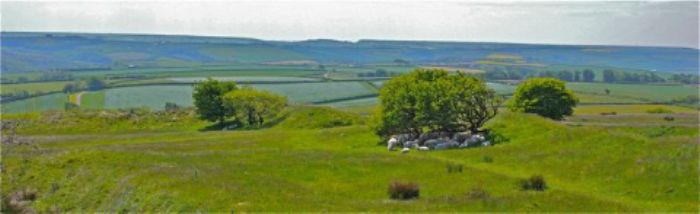
Flock of sheep - Blackdown Rings

Flock of sheep – Blackdown Rings

There were still bluebells everywhere and I wondered if that was the same when the Iron Age people were padding around, surveying the panoramic 360 degree landscape. There are also the remains of a Norman Motte-and-Bailey in one corner and I knew John would be up there in a trice. He always aims for the highest spot. The silence was profound – adding to the beauty of the surrounding countryside.
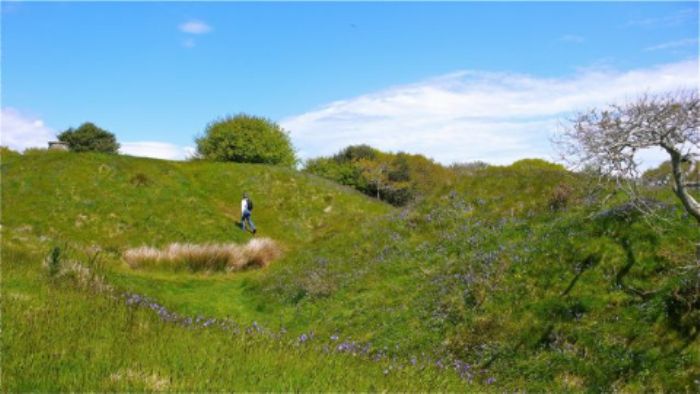
John climbs up the remains of the Motte-and-Bailey - Blackdown Rings ...

John climbs up the remains of the Motte-and-Bailey – Blackdown Rings …

We move on to Dorset tomorrow and wanted to walk along the sands, so it was back to the hotel and the rickety cliff staircase.
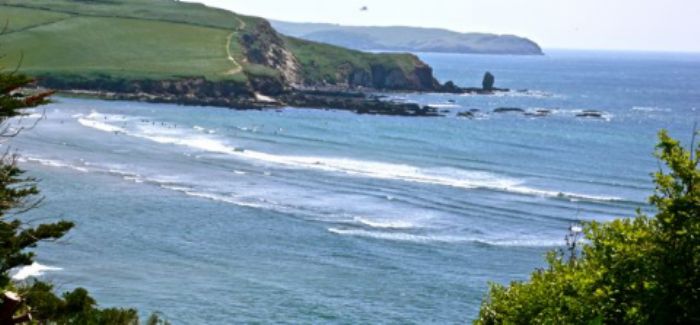
Surfers
Surfers

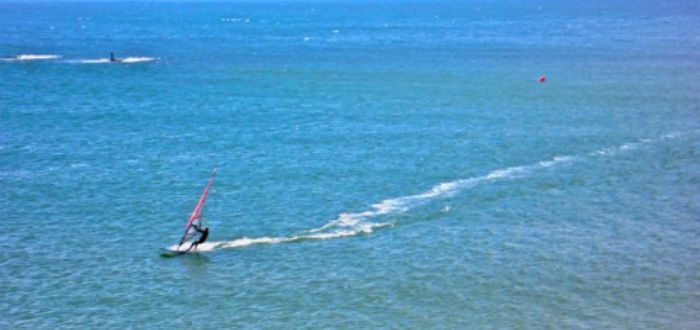
Tide coming in - windsurfer

Tide coming in – windsurfer

Cliff face full of holes ...

Cliff face full of holes …

Down on the beach with the tide going out – soon we will be able to walk around the headland to the island. Meanwhile, right by the water’s edge, we came upon a shoal of fish, some of them twelve inches long, their fins breaking the surface of the water as they swam around in a leisurely fashion, enjoying the warmth of the shallows, the sun on their backs. Grey mullet, we thought.
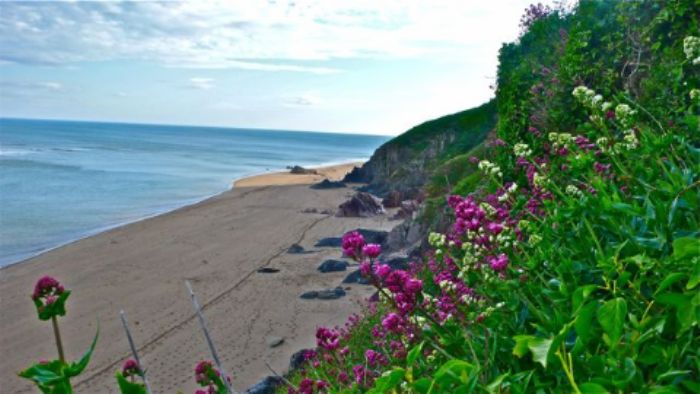
Half way up the cliff, looking down at footprints in the sand ...

Half way up the cliff, looking down at footprints in the sand …

Looking up and feeling dizzy  -  hold on!

Looking up and feeling dizzy – hold on!

We clambered up into the garden at the back of the hotel and watched a small boat going out fishing before making our way to the dining room. I never like saying goodbye but this has been a great start to the week.
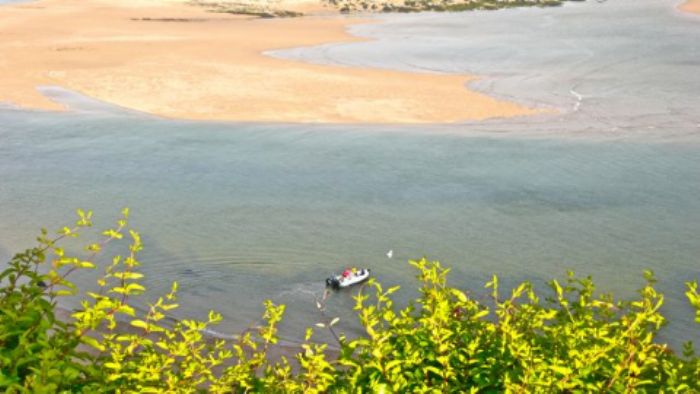
Small boat going fishing in the golden evening sun ...

Small boat going fishing in the golden evening sun …

DORSET

We set off early as we wanted to see some friends on the way. They live on the banks of the river Dart on the edge of Dartmoor and have built a ‘Mies van der Rohe’ type house, which is spectacular. At the cutting edge of design, yet fitting in with and even miraculously enhancing the landscape.

However, the car was once more tested to its limits as we took a turn down to the river. The unmade track was made up of ancient, deep potholes, grass two feet high in the middle. Wrong direction – steam coming out of our ears. Urban car bewildered yet continuing stalwart. The right direction wasn’t much of an improvement but finally the arrival was worth the aggro! The river is clear, moving fast but with deep, limpid pools for swimming.

Next stop, Plumber Manor – near Sturminster Newton. This old house sits amongst a haven of green. We crossed the river by a small white fenced bridge and parked under an enormous tree. The family have owned this site since the time of William the Conqueror and the present generation of it made us very welcome. Our bedroom was at the top of the stairs, where a portrait of Charles II inspected us closely. John is related but on the wrong side of the blanket. Could hardly wait for dinner and bed – both delicious and comfortable … zzzzzz ….. sea and country air offer very sound sleep.
View from our bedroom, Plumber Manor

View from our bedroom, Plumber Manor

We were recommended to go to Milton Abbas where there’s an abbey, a school and a ‘model’ village. Up on the top we had a wonderful view of the surrounding countryside at Bulbarrow before swooping down into the valley – we are getting better at driving along narrow country lanes!

Devon is somehow the extrovert county, Dorset the introvert. Both are fabulous but today I was entranced by the magical quality of the rise and fall of the landscape, rolling us up in a green and yellow carpet, dappled in sunlight.
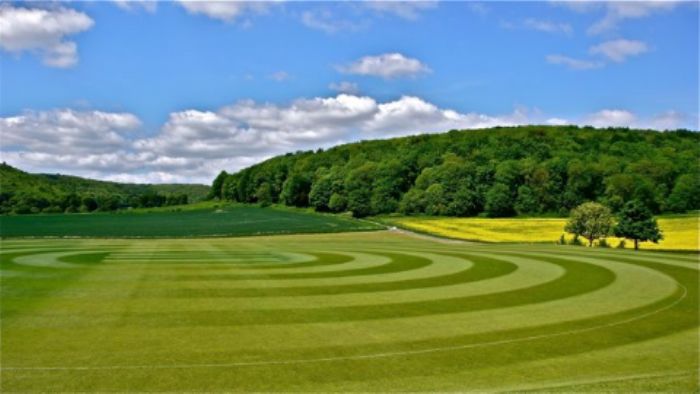
Down in the valley near Milton Abbas

Down in the valley near Milton Abbas

After exploring the old abbey grounds, now part of the school, we drove round into the village. This was the first ‘planned’ village in England, it is said. Lord Milton, who was 1st Earl of Dorchester and owned Milton Abbey, decided to move the original village, as it spoiled his view. It was relocated at Luccombe Bottom with the help of an architect and the landscape gardener, Capability Brown. The original village was demolished. Just the buildings … town planning was in its infancy but I think the villagers survived …
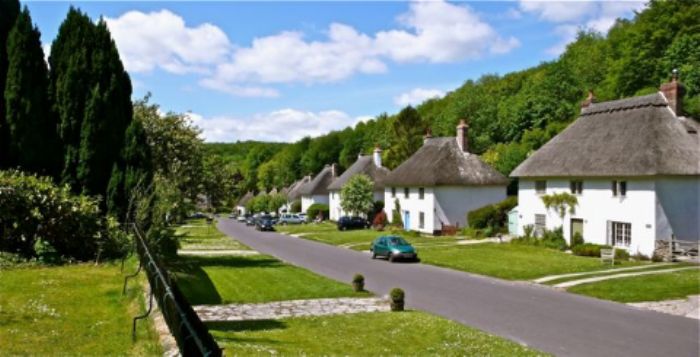
The 'planned' village of Milton Abbas ...

The ‘planned’ village of Milton Abbas …
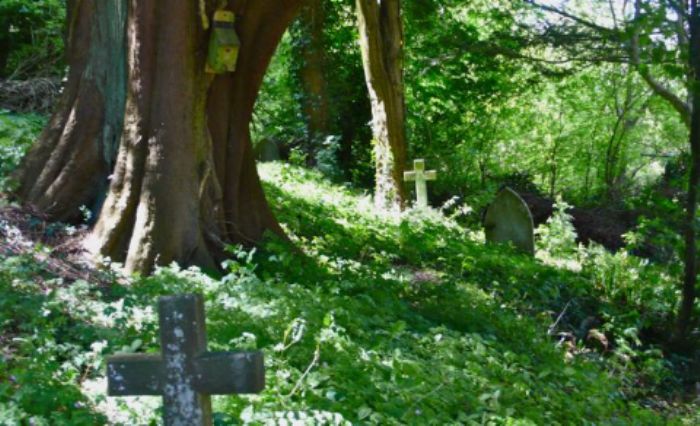
Milton Abbas churchyard
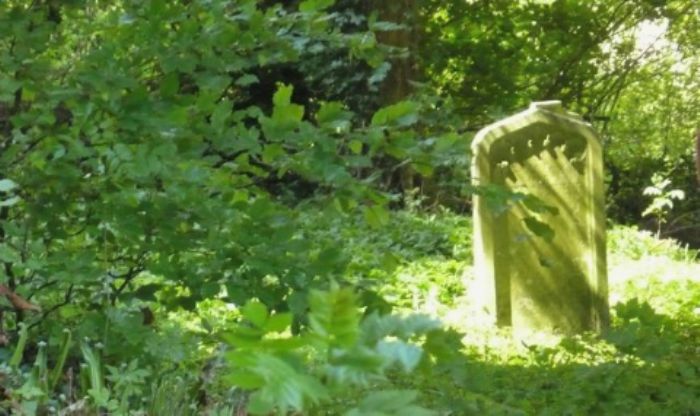
Milton Abbas churchyard

Gravestone bathed in the warmth of the sun ...

Gravestone bathed in the warmth of the sun …
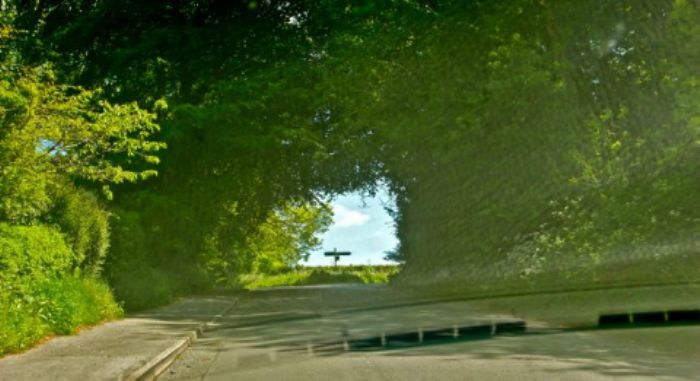
Pointing the way ahead ...

Pointing the way ahead …

Next stop Blandford Forum, where we parked by the river and walked up to the High Street. I noticed a bookshop and found Agatha Christie’s ‘Evil Under the Sun’ for 2.50. A ‘must’ after visiting Burgh Island! The last time I read Agatha Christie was in the sanatorium at school when I had bad ‘flu. The ‘san’ was set on the edge of the playing fields, surrounded by trees. I could hear the ‘pop’ of tennis balls near at hand but I wasn’t allowed visitors. Meanwhile, I devoured a whole shelf of Agatha Christies and I’m sure it aided my recovery … and she still seems to be the world’s best selling author … after all these years!

Bryanston school is nearby. We bought some cider and sandwiches and sat by the river, watching the boys rowing.
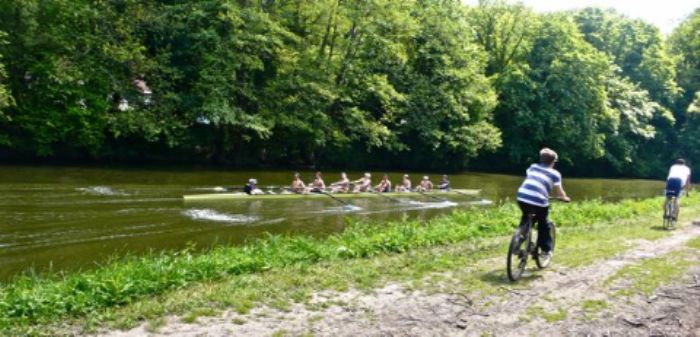
Rowing at Bryanston

Rowing at Bryanston

On the way back to Plumber – and dinner – we stopped off at Sturminster Newton water mill. There used to be mills like this a mile apart all along the river – but no more. This one is the best preserved.

The water mill started me thinking of Constable’s style of painting. He was brought up in Suffolk with a wealth of water mills all around, which he loved. Constable said he was trying to establish on canvas ‘English sunlight running through moist air, the wind rustling foliage and wimpling the water’. He also said ‘the sound of water escaping from milldams, willows, old rotten planks, slimy posts and brickwork … I love such things …Painting with me is but another word for ‘feeling’. Constable’s brushwork is swift, free and open – just like rushing water ….. he also used a method of painting called ‘scumbling’ to try and catch ‘one brief moment caught from fleeting time’.
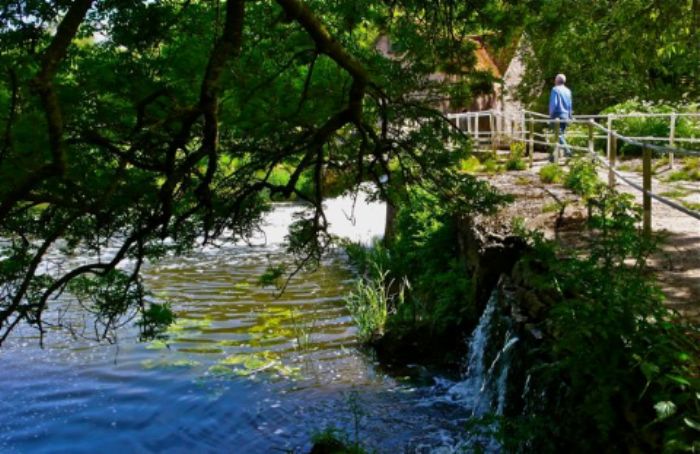
The mill race at Sturminster Newton
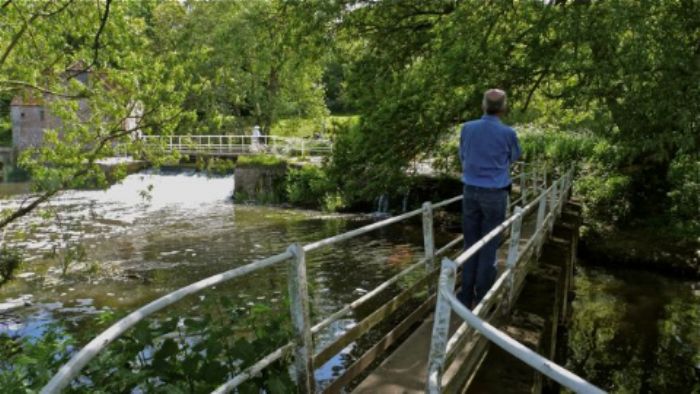
The mill race at Sturminster Newton

Sturminster Newton - crossing the bridge ...

Sturminster Newton – crossing the bridge …
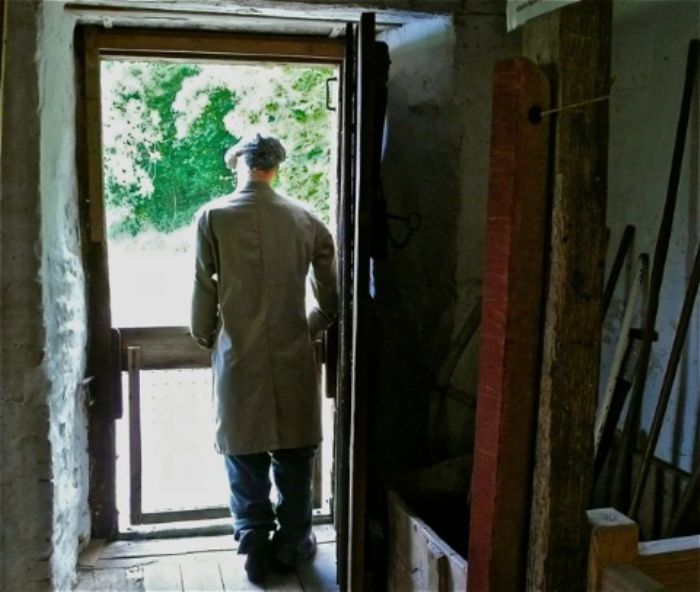
Sturminster Newton  -  The Miller's Tale

Sturminster Newton – The Miller’s Tale
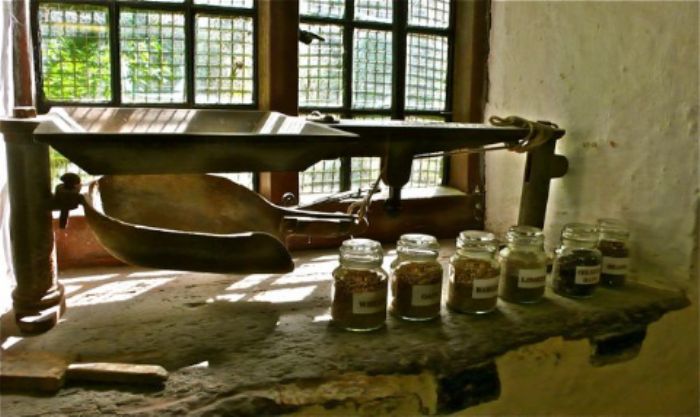
Sturminster Newton  -  inside the mill

Sturminster Newton – inside the mill

Thomas Hardy lived in a house by the river here when he was writing ‘Return of the Native’.
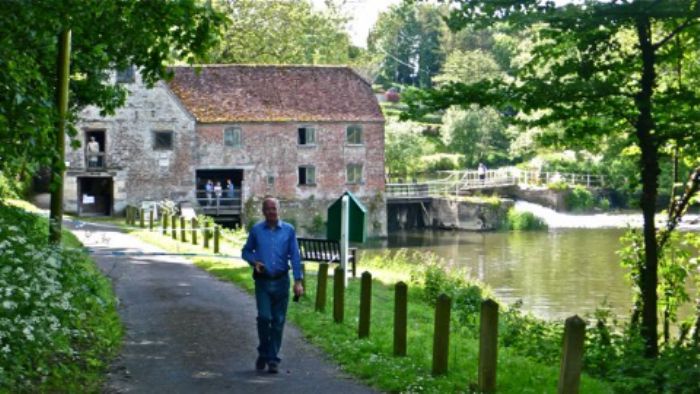
Evening sunshine at Sturminster Newton water mill ...

Evening sunshine at Sturminster Newton water mill …

Finally, the short distance back to Plumber. On the road we kept passing a sign which said ‘Cats’ eyes removed’. I thought this might shock foreigners who weren’t aware of what it was referring to. The savage customs of the English … leave kitty at home! However, the man from the North, Percy Shaw, who invented cats’ eyes for the road probably saved the lives of many motorists.

Hod and Hambledon hills near here were both Iron Age hill forts. The next day – Sunday – we drove to Child Okeford from where you can climb up Hod. Last time we did this – about four years ago – I remember seeing the most beautiful butterfly as I jumped over the stile. It was delicately patterned in shades of brown like filigree and spotted with small gold dots that shone like jewels. Today the whole hill was peppered with buttercups and daisies, speedwell, cowslips, dandelions. plantains (we used to call them soldiers) and rock rose.
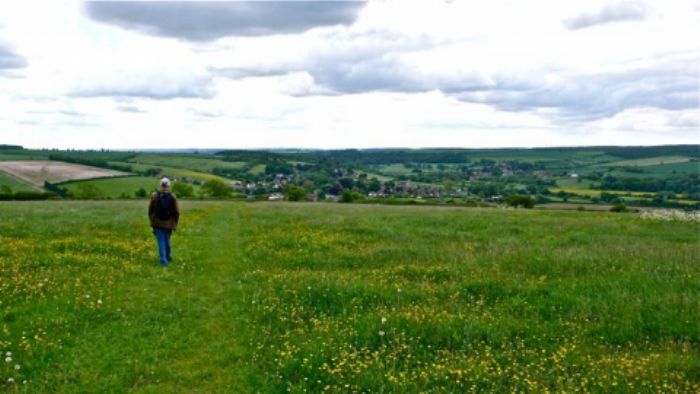
John on top of Hod Hill

John on top of Hod Hill

We met a woman, who looked as though she was from the Iron Age. She was big boned with an old fashioned face. If I say she resembled a mare, it was an attractive mare. We sat and talked for a while and then I followed John around the ramparts. We could see lots of regular hollows – maybe former dwellings, grazings or just shelters for animals. Two yellow brimstone butterflies fluttered by. Next time we must do Hambledon. We had to be back at Plumber as a friend from long ago who worked at ‘The Ecologist’ with Teddy Goldsmith was coming over to see us.
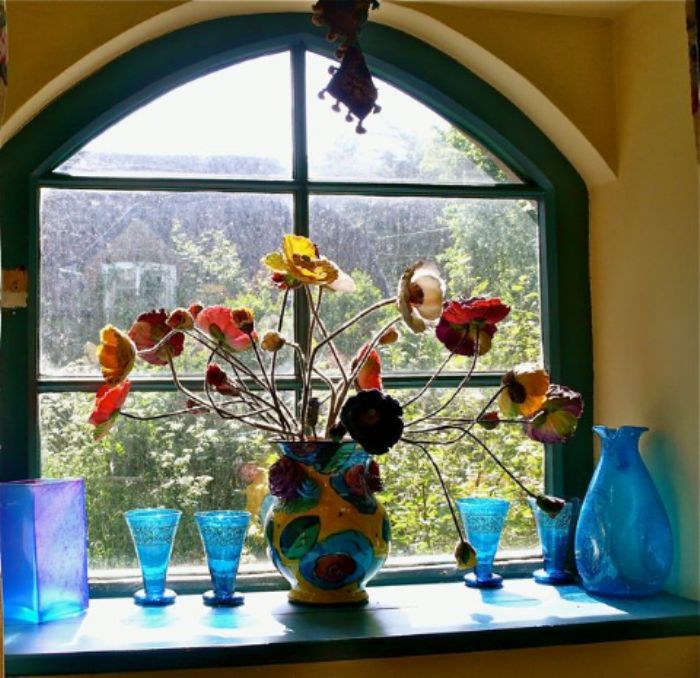
Window box

Window box

I had suggested to John he look up Nicholas because I thought he lived in Dorset and it turned out he was a ten minute walk over the fields from Plumber. So he came over and we made our way back to his house – more sheep to contend with – these ones were quite frisky with very dirty bottoms. We managed to find the way back later, only to have another drama.
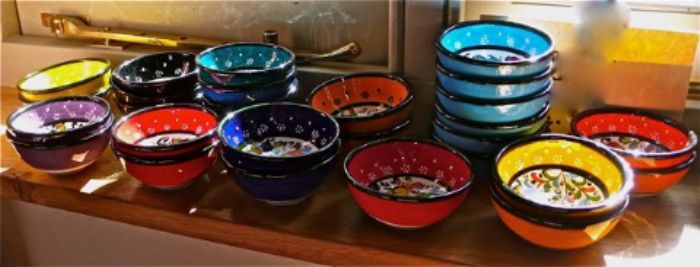
A Turkish window box

A Turkish window box

John suddenly realised he had left his bag with camera and car keys at the house. Nick was leaving for Prague not long after we left, so it was touch and go. Mobile phones not reliable in this neck of the woods! While John thrashed his way through the undergrowth terrorising the sheep, I lay on the bed and read Agatha Christie. John was (just) successful and returned in time for dinner and to be seduced by the ‘sweet trolley’!

The sun is again high in the sky. We got to the car, only to find it had been shat on in full force during the night by what must be enormous pterodactyls in the tree above. A bucket of water was needed and failing any cleaning fluid, I used my shampoo and found the frost scraper in the boot. Not such a good parking place after all.

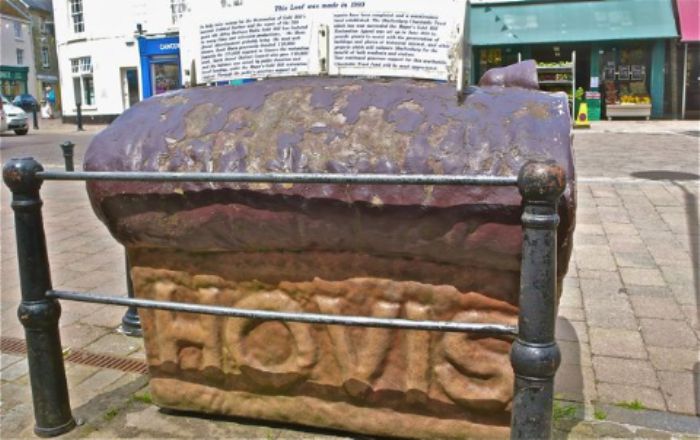
Shaftesbury wasn’t far away so we thought we’d take a look. It’s the highest town in Dorset and there’s a great view from the garden of the now ruined abbey. Gold Hill is where the TV ad for Hovis was filmed. Steep, cobbled, old fashioned and much photographed.
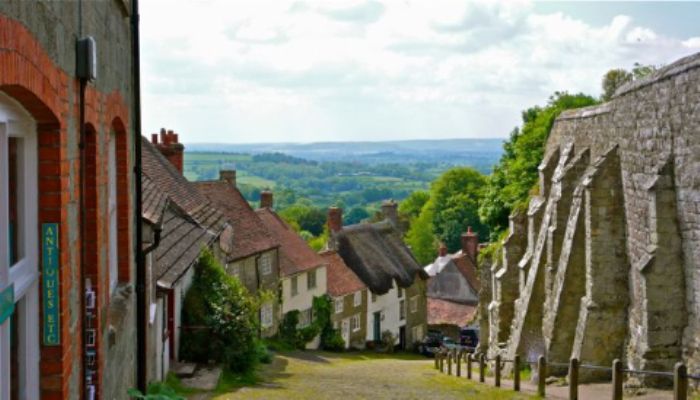
Shaftesbury  -  Gold Hill ...

Shaftesbury – Gold Hill …

... of 'Hovis' fame!

… of ‘Hovis’ fame!

John ended up buying a pair of pink trousers – in appreciation of the summer weather. Caroline, his sister, seemed to think they were only worn by certain ‘types’ – one being antique dealers. Maybe he could take that up as a second string to his bow. The colour quite suits him and it’s a change from jeans that everyone wears now. He is looking relaxed and optimistic. Dorset invites a slower pace of life and we seem to be taking to it – although evenings are reserved for book writing.
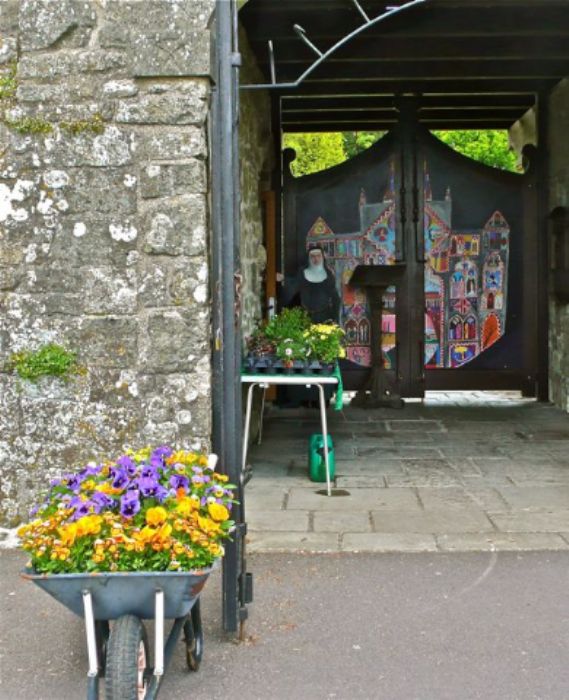
Shaftesbury - entry to the abbey gardens ...

Shaftesbury – entry to the abbey gardens …
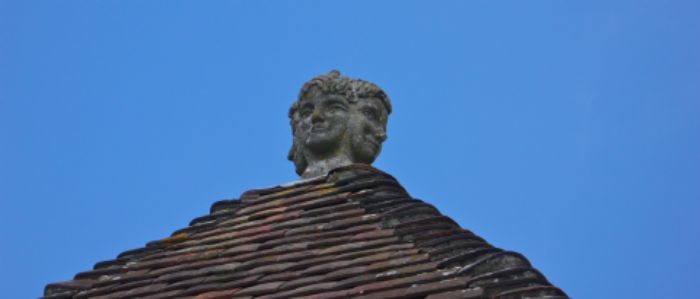
On watch at the abbey ...

On watch at the abbey …

We explored the abbey grounds and I bought some giant marbles in the shop. I don’t know why. It just felt satisfying to hold one in my hand. They are clear with yellow and green swirls – a bit like the Dorset landscape. I’ve also just finished a Simenon/Maigret book called ‘Maigret et le clochard’. I was very touched by what Maigret did with Toubib’s marbles. Simenon is definitely not just a crime writer. His understanding and relaying of the human condition to his readers is for me second to none and, being understated, makes much more of an impression. Maigret is special. I have a fantasy of being Mme. Maigret at times.

My mind was wandering towards my stomach and found itself strongly drawn to a slice of Dorset apple cake… ‘The Salt Cellar’ is a popular restaurant at the top of Gold Hill but it was busy and King Alfred’s Kitchen on the High Street was the place we chose to sit down. It’s run by a French woman and her husband and I would go back to Shaftesbury just to have another enormous slice of his apple cake – the best ever!
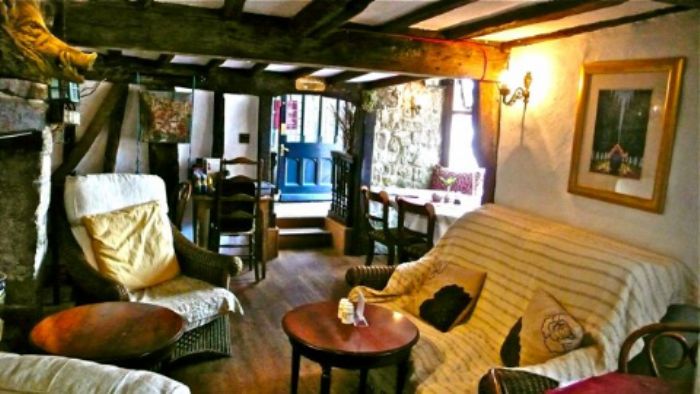
King Alfred's Kitchen - much enjoyed ...

King Alfred’s Kitchen – much enjoyed …
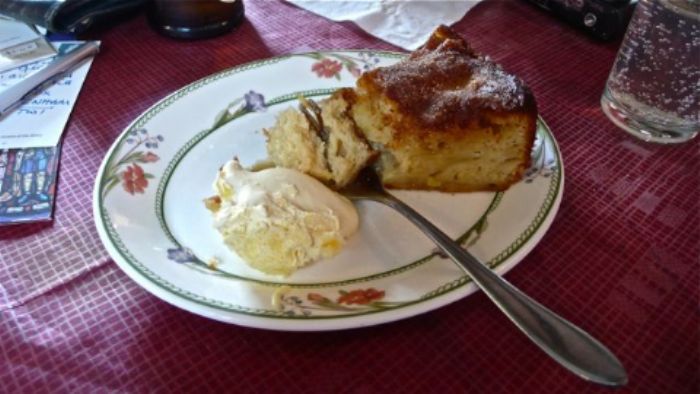
Dorset apple cake with clotted cream - I could eat it all over again!

Dorset apple cake with clotted cream – I could eat it all over again!
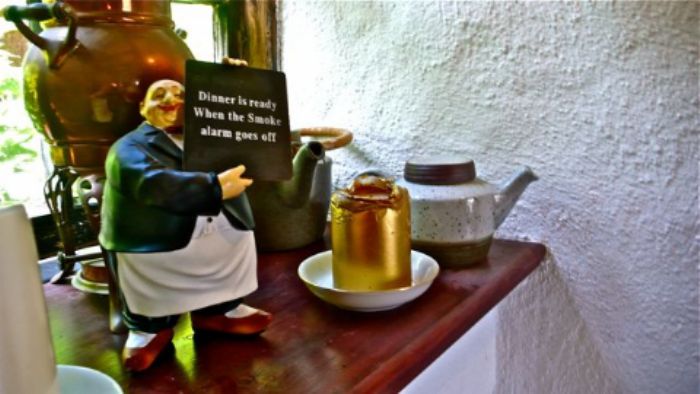
If the apple cake's anything to go by, I'd happily stay for dinner ...

If the apple cake’s anything to go by, I’d happily stay for dinner …

I shall remember Shaftesbury for pink trousers, yellow and green marbles and oozy apple cake with clotted cream. This marble fetish is reflected by the bottle glass window – looking through a glass sphere at the local high street. Is that bus a mirage? Public transport is a bit of a problem in the countryside but it does seem to turn up from time to time.
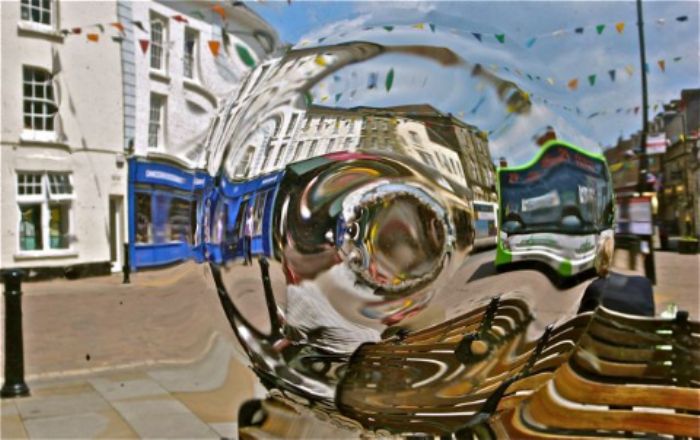
King Alfred's Kitchen - view from restaurant via bottle glass window ...

King Alfred’s Kitchen – view from restaurant via bottle glass window …

I’d noticed a small museum near ‘The Salt Cellar’ and persuaded John that it was worth a look. There are some wonderful Dorset ladies here who run the whole show.
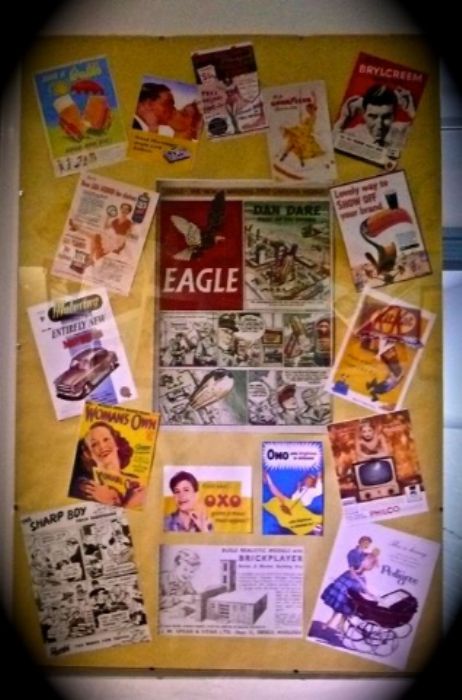
Shaftesbury Museum  -  a collection of 50s posters and magazines ...

Shaftesbury Museum – a collection of 50s posters and magazines …

There was an old film running on an old TV, showing a ‘Miss Marple’ figure standing watching American tanks coming through Shaftesbury during WW2.
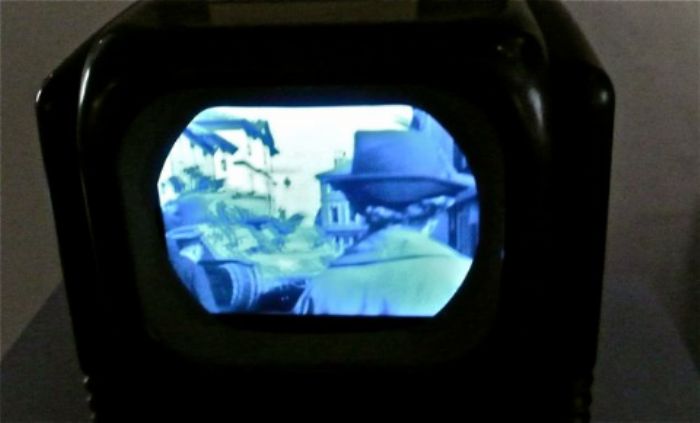
Miss Marple investigates
Miss Marple investigates

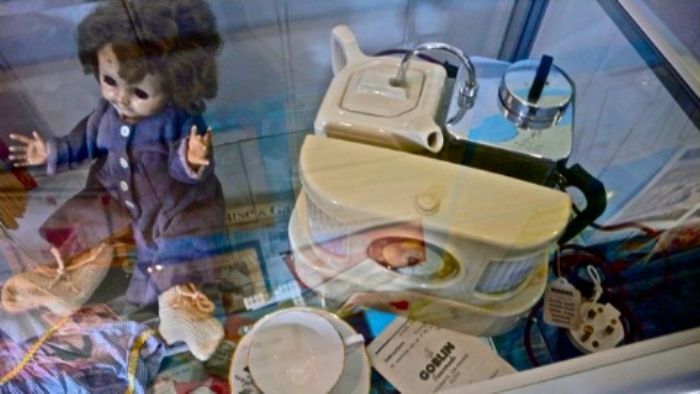
Relics from the 1950s!

Relics from the 1950s!

This photo has special memories for me. It’s not the doll I used to have – but the boyfriend, whose parents gave him a Goblin Teasmade for his 21st birthday?! No etchings in sight here – only the unmissable cup of tea. I could do with a Goblin Teasmaid now, instead of being one …

And then it was time to walk back down the High Street, pick up the car (so easy to park here!) and make our way to Badbury Rings.
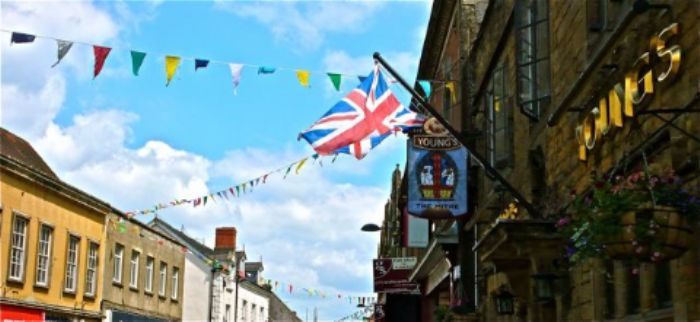
Au revoir Shaftesbury ...

Au revoir Shaftesbury …

Badbury Rings is an Iron Age hill fort which is quite small but perfectly formed. We walked all round the ramparts in half an hour. I could have lain down amongst the buttercups and daisies but I did notice some marauding black bullocks in the distance. This would be a perfect place for a picnic. However, I do remember once taking out a sandwich while we were walking in Switzerland – a greedy cow came out of nowhere snatched both sandwich and paper bag and ate the lot.
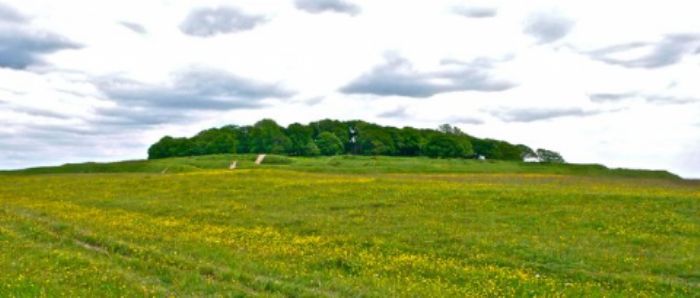
Badbury Rings  -  small but perfectly formed ...

Badbury Rings – small but perfectly formed …
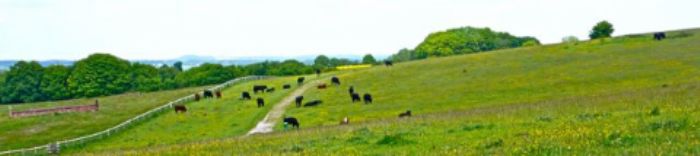
Not those pesky bullocks again?!
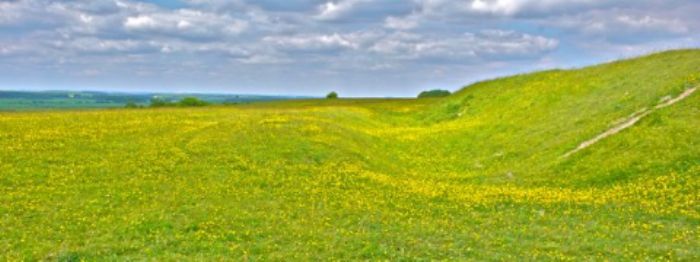
Not those pesky bullocks again?!

Where I wanted to lie down amongst the buttercups ...

Where I wanted to lie down amongst the buttercups …

But rather than lounging among the buttercups, it was on the road again, bound for Kingston Lacy – ten minutes away. The house was closed for renovation but the gardens were open. We drove along a wonderful avenue of beech trees – apparently, these are being replaced by hornbeams when their life comes to an end. Hornbeams are more disease resistant. Glad to be in time to see these at their best.
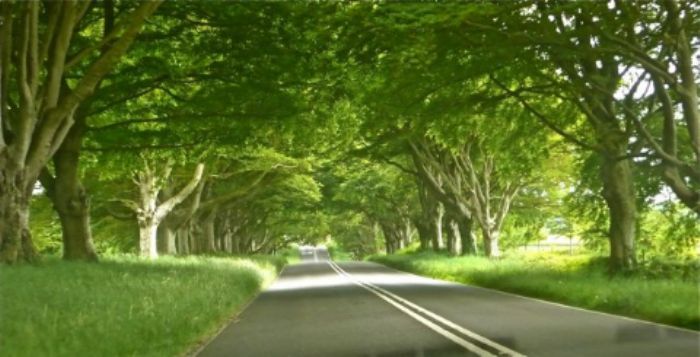
An avenue of beech trees lining the road to Kingston Lacy

An avenue of beech trees lining the road to Kingston Lacy

The last owner, William Bankes, bequeathed Kingston Lacy to The National Trust. He travelled a lot in the Middle East and a large obelisk, resembling Cleopatra’s Needle, stands in the grounds.

There’s obviously a bit of wear and tear but I noticed something that resembled a crusader knight racing out of the stone on horseback straight towards me. I expect that’s rather fanciful but it’s not exactly like finding Jesus or Mary on a slice of toast…
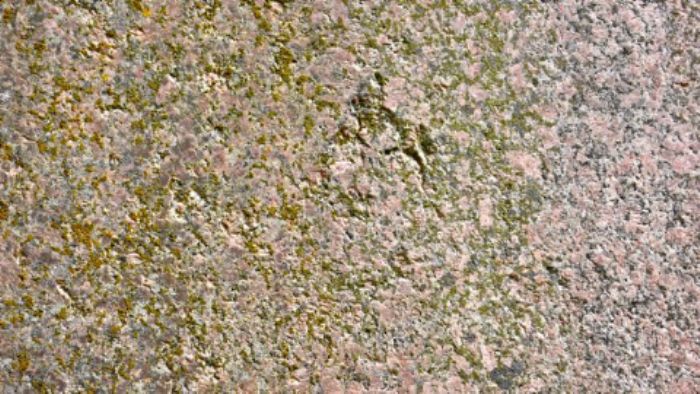
The Crusader and the Obelisk ...  ?  Who has a good imagination?

The Crusader and the Obelisk … ? Who has a good imagination?

John is very well read on this period of history. I think he was fired up by reading ‘Knight Crusader’ by Ronald Welch, as a boy. Over ten years ago we went to Syria and our walk around Krak des Chevaliers is still deeply imprinted on my brain.
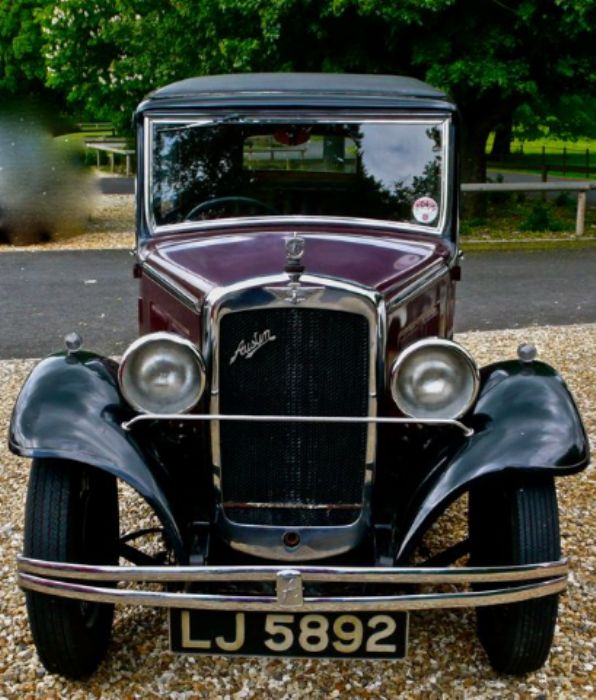
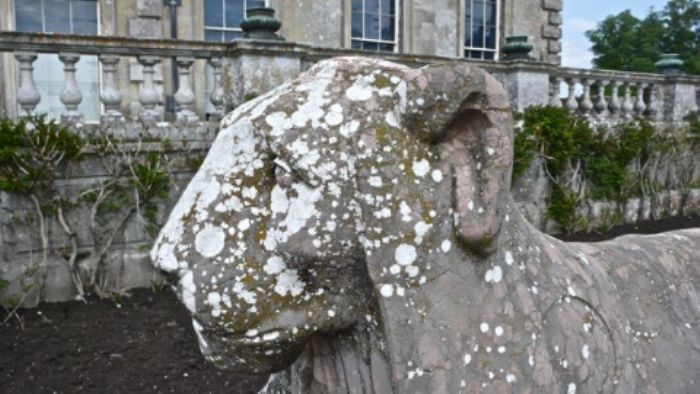
A beauty in the car park
A beauty in the car park

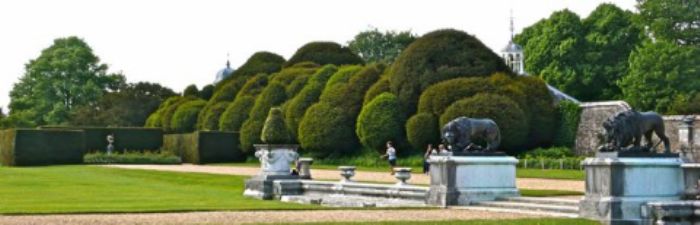
Hedging at Kingston Lacy
Hedging at Kingston Lacy

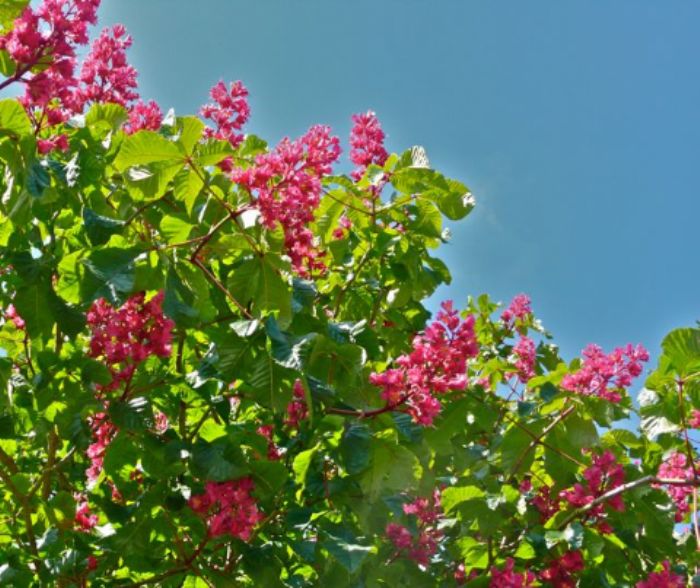
A pink horse chestnut tree
A pink horse chestnut tree

An ancient retainer - Kingston Lacy

An ancient retainer – Kingston Lacy

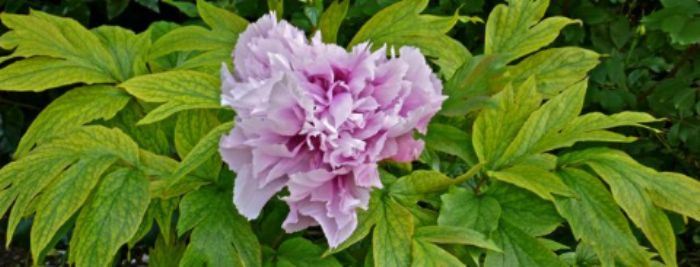
Kingston Lacy - paeony pink

Kingston Lacy – paeony pink

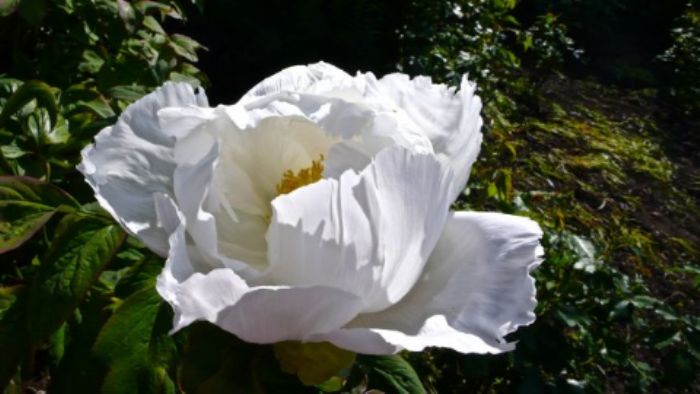
Kingston Lacy  -  and white ...

Kingston Lacy – and white …

Back to Plumber on a road as much unlike Hammersmith Broadway as you could hope to see! We are still on holiday!
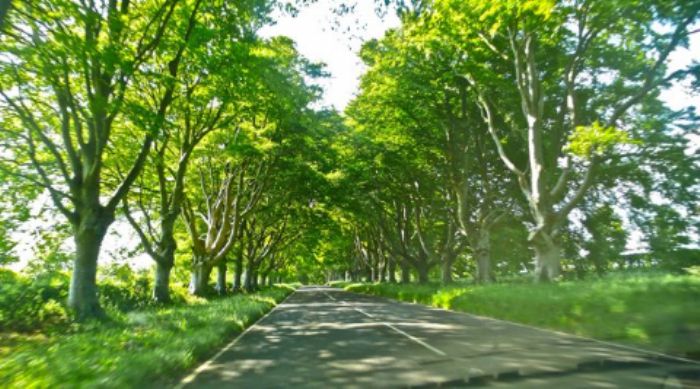
A sunlit evening on the way home ...

A sunlit evening on the way home …

I notice I say ‘home’ – Plumber gives me that feeling but we only have one more full day. This is to be spent with Julia and her new partner Jamie – a motorbike fiend but a very nice one!

On the way we are diverted by another huge piece of metal. Quite extraordinary!
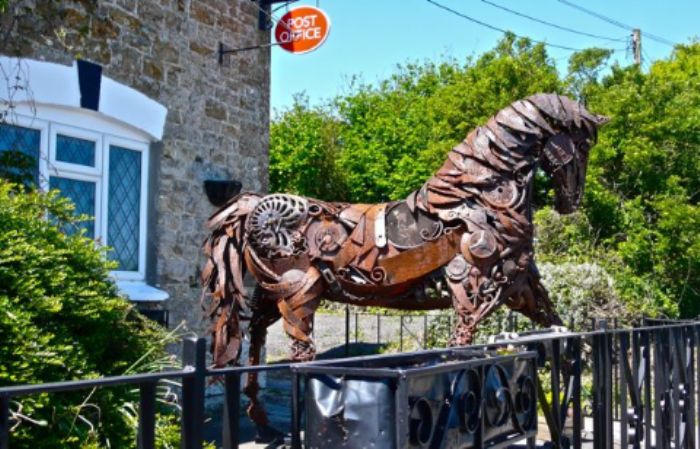
Waiting for a knight crusader ...

Waiting for a knight crusader …

Julia and Jamie live near Beaminster – and we attempted to travel cross country, where there seemed to be many dead ends. We passed by Bishop’s Caundle, Minterne Magna, Melbury Bubb (dead end!), Sydling St. Nicholas, Toller Porcorum, and we were only ten minutes late – tho’ slightly flustered!

It was great to see their new farmhouse – turn to John’s blog to see details of the afternoon adventure deep in the woods. My photos are not up to much, as it was enough for me to scramble through the undergrowth – but fascinating to see all this creative stuff going on in seemingly the middle of nowhere! John and Julia were greatly intrigued.
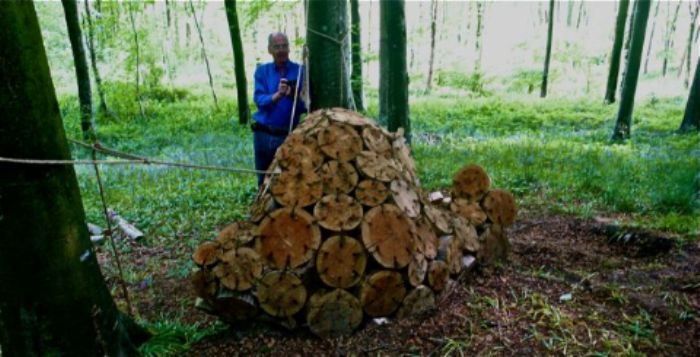
A genius seamstress at work in the forest ...

A genius seamstress at work in the forest …

The next morning we dropped by Bryanston school, where Julia’s son, Connor, took us on a tour and we got to see the Art Department, which is very impressive. This is also on John’s blog. On the way round, we met a maths teacher who was just about to retire. John remembered him as a boy at school! All I can say here is that whoever goes to Bryanston today is very lucky!

Sherborne was on our way back and we wanted to track down Tim Boon, who had a gallery in Barnes called ‘Amalgam’ for many years, before he moved here. It’s a very lovely, honey coloured town and seemingly well-to-do. We didn’t find Tim but John recognised a well known war photographer in the street. We walked by Sherborne school and then it was time to get on the road back to London.

Oddly, when we got home, there was a letter from Tim, inviting us to his last show in England. He was off to live in Australia.
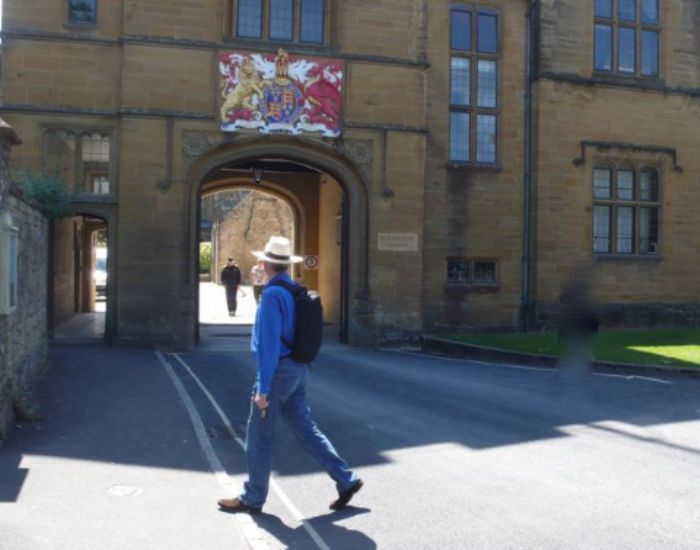
Passing the entrance to Sherborne school

Passing the entrance to Sherborne school

I was rather dreading the drive home although it was shorter than coming. We made for Ringwood and the M3. But as we were leaving Dorset we were passed by a more ancient form of transport. A fitting end to the week. And we had cider in the boot of the car.
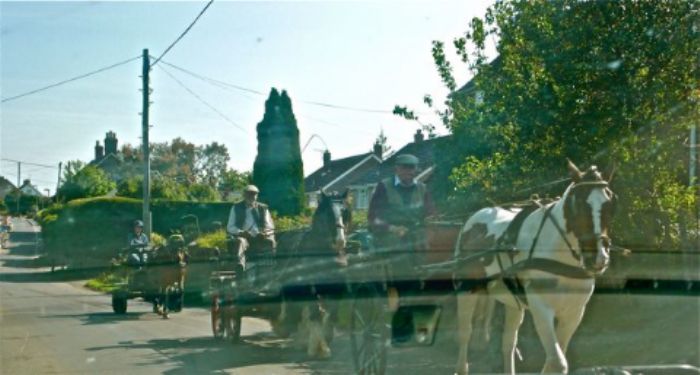
Leaving Dorset  ...

Leaving Dorset …

END
Posted in Uncategorized | Comments closed

March and April

These two months weather patterns have merged into one – one which could be described quite simply as miserable. A couple of days have escaped to be bright but I only remember two which were sunny AND warm, without a biting wind.

‘It was one of those March days when the sun shines hot and the wind blows cold: when it is summer in the light and winter in the shade’. (Charles Dickens).

I can see why a lot of small, furry animals hibernate until the underlying warmth of the ground stimulates their blood. Bloodstone is a symbol for March. Its ‘blood’ has remained heavy, dark and cold. I found myself yawning a lot and being able to nod off at the drop of a hat. The constant cold laid waste to my brain cells, extinguishing creative juices in the same way as the garden remained emphatically ‘dead’ in the relentless grip of winter. I looked in vain for buds on the apple tree and the grape vine. The olive looked sere and dry – springtime was obstinately absent. Maybe I should have left these shores for southern climes.

Barnes birds waiting for Springtime ...

Barnes birds waiting for Springtime …

One day, the sky was blue but it was the blue of glacier ice. On another day, the fragile blue of a wild bird’s egg.

Sunshine sparkling like ice across the Thames ...

Sunshine sparkling like ice across the Thames …

Low tide near Barnes Bridge ...

Low tide near Barnes Bridge …

Grey and uninspiring for the most part, cutting cold with sharp bursts of sun, followed by hailstorms, heavy rain or persistent drizzle and at the back of it all that chilling, raw damp, which gnaws relentlessly at your bones, making you weary. And because you hadn’t achieved a great deal, and were somehow unable to do so, it settled you inevitably into a deep, stultifying gloom.

Dodging the tentacles of the ‘noro virus’ we ran into the open maw of the ‘100 day cough’, with its grim attendants. However, we kept up a simulation of normality, keeping going with early nights, honey and lemon drinks, thumbing our wet noses at this rather repulsive and unwanted companion.

Some actual rather than virtual repulsive types knocked John off his bike in central London. Let’s hope the police will do something about it, even though the brain dead miscreants drove off. Plenty witnesses offered to help. I can’t help but feel that some people are ‘mal élevé’. But I won’t pontificate on that here. it would take up too much space.

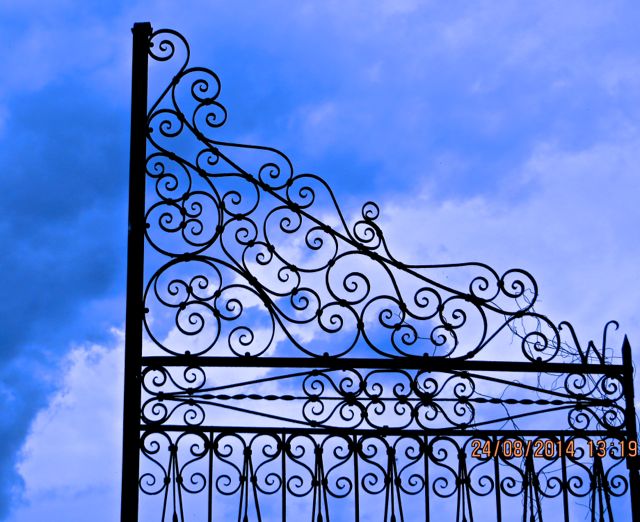
This all cast a pall on daily life in general but meanwhile, refreshingly in hindsight, much was achieved. Tree cutters arrived, roof leaks were mended, the oven recovered with a new element installed, wrought iron gates replaced the rotten wooden ones, acupuncture was experimented with, magic insoles were offered by Mr. Catto (podiatrist), spring cleaning of rooms and visits to the tip inspired both highs and lows of mood. ‘Our life is March weather, savage and serene in one hour’ (Ralph Waldo Emerson).

Cold sunset in Barnes 2013

Cold sunset in Barnes 2013

Joy of meeting up with friends to see Manet and George Bellows at the Royal Academy, Lichtenstein at the Tate, an ascent of The Shard, Barocci at The National Gallery, Tudor Treasures at the V&A, Elizabeth Frink at ‘The Lighthouse’ in Woking and BBC 4 coming up trumps with programmes by Adam Nicolson on writing in the 17th century – ‘The Century that Wrote Itself’, Andrew Graham Dixon on ‘High Art in the Low Countries’ followed by the renovation of The Rijksmuseum, and an insightful hour on the art and genius of Joseph Mallord William Turner.

More insights into Pompeii and Herculaneum – and I mustn’t leave out Michael Portillo’s railway journeys all through Britain and Europe, holding his ‘Bradshaw’s’ guide close to his chest. This is a wonderful series of journeys by rail peppered with a fascinating miscellany of historical anecdotes. I thought I didn’t like Michael Portillo when he was an MP. I’ve completely changed my mind and it’s a good feeling to be able to do that.

Looking south from the Shard ...

Looking south from the Shard …

View from The Shard - HMS Belfast

View from The Shard – HMS Belfast

I’ve read two ‘Maigrets’ in French. ‘L’indicateur’ and ‘L’amie de Mme. Maigret’ since the beginning of the year. I enjoy Simenon’s writing. He keeps up the tension of a ‘whodunnit’, along with great descriptive powers and easy dialogue which draws you in almost as a player in the story. I could meet any of these characters in the street and recognise them. And I hope I retain some of the new vocabulary I’ve learned! I still keep sneezing, so I know my repulsive companion is still sticking to me like glue (urghh) but hope he is planning now to move on elsewhere. He has caused disruption and depression but not death.

The magnolia stellata is now sparkling with starry blooms, snowdrops are being followed by forget-me-nots and narcissi and there are buds appearing on the apple and grapevine. The 25th April saw a high in central London where you could walk without a coat. I wasn’t dressed for the occasion. And a Canadian friend came to see us on the 19th of April, citing that they had had snow in Canada as recently as last week.

Walking upriver on a cold, wet, March day ...

Walking upriver on a cold, wet, March day …

I came upon this cigarette packet left on the river wall. ‘Smoking kills’ it announced. So would the river if you fell in today.

The shape of things to come ... ?

The shape of things to come … ?

Always worth waiting a while … just in case. ‘Hope is the feeling you have that the feeling you have isn’t permanent’ – Felicia, in “Finishing Touches’ (1973)

I’ve definitely been ‘in the doldrums’ but I’m looking forward to May now!

END
Posted in Uncategorized | Comments closed

Hugh’s Fish Fight gathers momentum

I dread being in large groups of people – nor do I like shouting slogans – but Hugh Fearnley-Whittingstall’s ‘Fish Fight’ had me putting a poster in our car. I support 100% what he’s trying to do, both with ‘discards’ and now with trying to persuade the government to create many more marine conservation areas around the coast of Britain. It’s an uphill task that he has taken on and he deserves all the help he can get from the British public. We will all benefit.

Arriving outside Houses of Parliament  -  an important message

Arriving outside Houses of Parliament – an important message

And that’s why I made myself join his demonstration outside the Houses of Parliament on 25th February. A raw grey morning we had of it but it was cheering to see so many people determined to get their message across. If we don’t look after our coastal waters and encourage other countries to do the same, we will soon have to bear the consequences of destroying the environment upon which we depend. Give and take has to make a healthy balance for survival. Both fishing for food and the diversity of the seas and sealife must be preserved across the planet. We must send out that message loud and clear. It’s that ‘rights and responsibilities’ issue. We can’t have one without the other.

Hugh and company  -  making a difference ...

Hugh and company – making a difference …

Fishfight  -  we need your support!

Fishfight – we need your support!

Hugh's fishfight - keep tweeting ...

Hugh’s fishfight – keep tweeting …

I remember as a child, sitting on the sea wall in Largo (Fife), dangling my legs and eating delicious fish and chips out of a newspaper with a bottle of Irn-Bru. At Pittenweem, a village nearby, the fishing boats would come in with their trawl and boxes of fish would be slung out and auctioned off on the pier. My maiden aunts would return triumphantly with a box of plaice or haddock, which they would grill and serve for supper with fresh lemons and boiled potatoes, cut into slices and fried. And for pudding, it would be the raspberries we had collected in the hedgerows with a dollop of Forte’s vanilla ice cream, collected by me from the local shop in Granny’s large blue and white jug. I just sped along the pavement with it, to get home before it melted! That supper was my favourite.

And so was paddling among the rockpools at Anstruther and Elie, finding limpets, red sea anemones, shrimps, whelks, tiny scuttling crabs and shy, almost transparent blennies, starfish and shells of all kinds. I especially loved cowrie shells, which we hunted for along the beach at low tide, along with bladderwrack seaweed, which made a satisfying ‘pop’ and dogfish egg cases, which were both mysterious and elegant in black – with twirly tendrils.

A sustainable seaworld  -  don't lose us!

A sustainable seaworld – don’t lose us!

Fishfight - it's a long haul but worth it for us all ...

Fishfight – it’s a long haul but worth it for us all …

Seeing Hugh’s film about dredging for scallops along the sea bed and destroying the whole marine environment at the same time made me both incensed and miserably depressed. I could not stand by and just let it happen and it was heartening to see such a big turn out at the Houses of Parliament. And a big mix of young and old.

Fishfight - a great turn out ...

Fishfight – a great turn out …

Fishfight - well done, Hugh!

Fishfight – well done, Hugh!

And at the end of the day a lone wolf lends her support ...

And at the end of the day a lone wolf lends her support …

We have to make this happen – keep up the support! And well done, Hugh! For marine conservation text ‘protect’ to 84424. I felt so cheered to have actively joined in here on 25th February.

Posted in Uncategorized | Comments closed